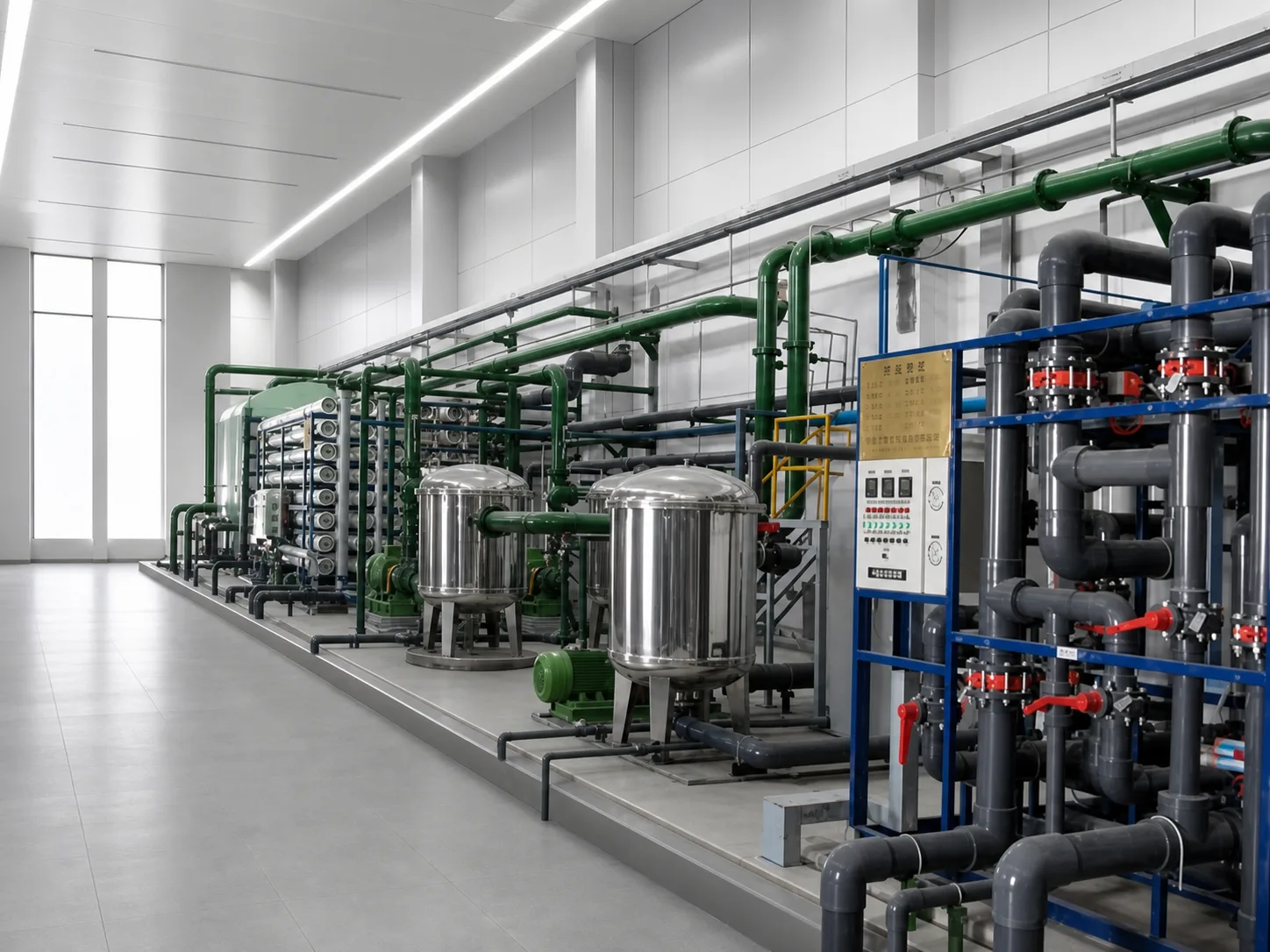
KONCHE industrial ultrapure water systems are designed for semiconductor, PCB, display, photovoltaic, battery and precision-manufacturing processes. The official product page specifies RO + EDI + UV treatment, resistivity of at least 18.2 MΩ·cm, TOC up to 0.5 μg/L and a standard capacity range of 0.5–100 m³/h.
KONCHEINDUSTRIAL WATER TREATMENT SYSTEMSMODEL KONCHE UPW · INDUSTRIAL ULTRAPURE WATERPOLISHING TRAINLOOP DISTRIBUTIONVERIFIED FEEDENGINEERED BY KONCHE · 2026
QUICK TECHNICAL ANSWER
What is an Industrial Ultrapure Water System?
KONCHE industrial ultrapure systems: pretreatment, double-pass RO, EDI and UV trains producing ≥18.2 MΩ·cm water with TOC ≤0.5 μg/L for electronics and precision manufacturing.
What it delivers
One product family: 15–18.2 MΩ·cm EDI polish, 1–10 MΩ·cm mixed-bed deionization, and ≤2 μS/cm pharmaceutical purified water
Stable ≥18.2 MΩ·cm ultrapure water with TOC ≤0.5 μg/L
Chemical-free continuous deionization — no acid or caustic regeneration, no regenerant waste
PLC automatic operation with alarms; modular 0.5–100 m³/h design scales by adding modules
Why trust KONCHE
Designed to GB/T 11446.1 electronic-grade water standard
Nearly 30 years of water-treatment engineering with 500+ delivered projects
RO membranes, EDI stacks, filters and UV lamps supplied directly from KONCHE at factory pricing
KONCHE industrial ultrapure water systems are designed for semiconductor, PCB, display, photovoltaic, battery and precision-manufacturing processes. The official product page specifies RO + EDI + UV treatment, resistivity of at least 18.2 MΩ·cm, TOC up to 0.5 μg/L and a standard capacity range of 0.5–100 m³/h.
KONCHE ultrapure systems combine multi-media and activated-carbon pretreatment, double-pass RO, EDI and UV sterilization with an optional polishing mixed bed. Capacities span 0.5–100 m³/h with resistivity ≥18.2 MΩ·cm and TOC ≤0.5 μg/L, engineered to GB/T 11446.1 electronic-grade water. Typical projects: semiconductor and wafer fabs, PCB, optoelectronic displays, photovoltaics, lithium batteries and electroplating lines.
WORKING PRINCIPLE
01
Pretreatment
Multi-media, activated carbon and security filtration reduce suspended solids, residual chlorine and particles before RO.
02
Double-pass RO
Two membrane passes provide primary desalination and reduce the ionic load on EDI.
03
EDI deionization
Ion-exchange resin, selective membranes and a DC field continuously transfer residual ions into the concentrate stream.
04
Final polishing
254 nm UV supports microbial control; 185 nm UV, polishing resin and terminal filtration are added when the final specification requires them.
PROCESS ROUTE — RO + EDI
Continuous electrodeionization (EDI) polishes double-pass RO permeate to 15–18.2 MΩ·cm without acid or caustic regeneration — the chemical-free deionization backbone of KONCHE industrial ultrapure trains.
01
RO pretreatment
RO reduces dissolved salts and prepares EDI feed water; the official reference requires EDI feed conductivity no higher than 40 μS/cm.
02
Ion migration
Cations and anions move through their corresponding ion-exchange membranes under the DC field.
03
Continuous resin regeneration
H⁺ and OH⁻ generated from water dissociation regenerate the ion-exchange resin during operation.
04
UV protection
254 nm UV is used after EDI when microbial control is required in storage and distribution.
EDI train technical data
Parameter
Value
Model range
KCEDI-0.5 to KCEDI-100
Capacity
0.5–100 m³/h
Product-water resistivity
15–18.2 MΩ·cm
TOC
≤0.5 μg/L
EDI-stage recovery
90–95 %
EDI feed conductivity
≤40 μS/cm
Operating voltage
50–600 V DC
Operating current
1–30 A DC
EDI stacks
1–8 per system
EDI model range
Model
Capacity
Typical application
KCEDI-1
1 m³/h
Small laboratories and pilot systems
KCEDI-10
10 m³/h
Mid-size plants, pharmaceutical formulation
KCEDI-30
30 m³/h
Large enterprises, electronics and semiconductors
KCEDI-100
100 m³/h
Central ultrapure-water supply
PROCESS ROUTE — ION-EXCHANGE DEIONIZATION
Mixed-bed ion exchange delivers 1–10 MΩ·cm deionized water — as a standalone polishing route or as the final barrier behind EDI when the approved water-quality target requires it.
01
Cation exchange
H-form cation resin removes Ca²⁺, Mg²⁺, Na⁺ and other cations while releasing H⁺.
02
Anion exchange
OH-form anion resin removes sulfate, chloride, bicarbonate and other anions while releasing OH⁻.
03
Mixed-bed deionization
H⁺ and OH⁻ combine to form water, allowing product-water resistivity of 1–10 MΩ·cm.
04
Chemical regeneration
Exhausted resin is separated and regenerated using hydrochloric acid and sodium hydroxide before returning to service.
Deionization train technical data
Parameter
Value
Model range
KCDI-0.5 to KCDI-100
Capacity
0.5–100 m³/h
Product-water resistivity
1–10 MΩ·cm
Resin
Gel or macroporous uniform-particle resin
Vessel
FRP or rubber-lined steel
Regenerants
HCl + NaOH
Reference regeneration cycle
8–24 , dependent on ionic load hours
Service velocity
20–40 m/h
Working pressure
0.2–0.6 MPa
Deionization model range
Model
Capacity
Typical application
KCDI-1
1 m³/h
Small laboratories, industrial rinsing
KCDI-10
10 m³/h
Mid-size plants, boiler make-up
KCDI-50
50 m³/h
Large enterprises, chemical batching
KCDI-100
100 m³/h
Industrial bases, central pure-water supply
CORE BENEFITS
Advantage
Customer benefit
Stable 18.2 MΩ·cm
Double-pass RO + EDI process keeps quality fluctuation small — product yield is protected.
No acid or caustic regeneration
EDI electro-regeneration discharges no regenerant waste — no pressure from environmental inspections.
Fully automatic operation
PLC + touch screen with multiple protections and alarms; no dedicated operator required.
Modular design
Full 0.5–100 m³/h range; expanding capacity only adds modules.
Consumables supplied direct
RO membranes, EDI stacks, filters and UV tubes direct from KONCHE — genuine parts at lower cost.
Note: capacity and configuration of every model can be customized to actual project requirements.
INDUSTRY APPLICATIONS
Industry
Water point
System value
Semiconductors / wafer fabs
Wafer rinsing, etching solutions
Zero ion residue protects yield.
PCB
Developing, plating and final rinse
Prevents ionic contamination and short circuits on board surfaces.
Optoelectronic displays
Ultrasonic glass-substrate cleaning
Particle- and mark-free surfaces raise yield.
Photovoltaics
Wafer rinsing and texturing
Stable water quality keeps conversion efficiency consistent.
Lithium batteries
Electrode materials and cell rinsing
Low metal-ion water protects battery safety and service life.
Electroplating and surface finishing
Bath make-up and workpiece rinsing
Fewer impurities carried in — brighter, more uniform coatings.
APPLICATION — PHARMACEUTICAL PURIFIED WATER
The same product family delivers pharmacopoeia purified water — conductivity ≤2 μS/cm, microbes ≤100 CFU/mL, TOC ≤500 ppb — on hygienic 316L trains designed around GMP qualification workflows.
01
316L stainless steel
Hygienic piping, valves, storage and wetted components can be specified in 316L stainless steel.
02
Controlled surface finish
Internal surfaces are electropolished to Ra ≤0.4 μm.
03
Full circulation
The distribution loop is designed to minimize stagnant water and return continuously to storage.
04
Online monitoring
Conductivity, TOC, flow and temperature monitoring supports operating records and deviation review.
05
Validation documentation
DQ, IQ, OQ and project-specific PQ support can be defined in the contractual documentation scope.
Pharmaceutical train technical data
Parameter
Value
Water-quality reference
Chinese Pharmacopoeia 2020 purified water
Conductivity
≤2 μS/cm at 25 °C
Microorganisms
≤100 CFU/mL
TOC
≤500 ppb
Capacity
0.5–20 m³/h; customizable
Sanitization
80–85°C hot-water sanitization
Piping
316L stainless steel, hygienic design
Control
PLC + touchscreen; data-recording options
Pharmaceutical model range
Model
Capacity
Typical application
KC-PW-0.5
0.5 m³/h
Laboratories, small preparation rooms
KC-PW-2
2 m³/h
Mid-size pharmaceutical plants, API production
KC-PW-5
5 m³/h
Formulation lines, medical-device rinsing
KC-PW-10
10 m³/h
Large pharmaceutical enterprises, cosmetics
KC-PW-20
20 m³/h
Central supply for large plants (custom)
SELECTION GUIDE
01
Set the final-water target
Confirm resistivity, TOC, particle, microbial and silica limits from the production process.
02
Test the source water
Use a current water analysis to size pretreatment, RO recovery and cleaning requirements.
03
Confirm demand
Calculate peak flow, daily volume, operating hours, redundancy and storage.
04
Define the distribution loop
Confirm piping material, loop length, return conditions, UV position and point-of-use requirements.
10 m³/h ultrapure-water system delivered for an electronics plant in Shenzhen.
IndustryElectronic manufacturing
Capacity10 m³/h
ProcessDouble-pass RO + EDI
Municipal feed water; output resistivity stable at 18.2 MΩ·cm. Replacing the previous mixed-bed system eliminated acid and caustic regeneration, cutting annual operating cost by about 20%. The plant has run continuously and stably for three years.
FAQ
How is system price determined?
Price depends on capacity, feed-water condition, final-water target, materials, redundancy, monitoring and distribution scope.
How do I choose EDI or a polishing mixed bed?
EDI is suited to continuous deionization. A polishing mixed bed can be added as the final barrier when the approved water-quality and reliability target requires it.
Why can resistivity fall?
Common causes include exhausted pretreatment, RO fouling, EDI scaling, carbon-dioxide ingress, microbial growth or distribution-loop contamination.
What determines operating cost?
Power, recovery, pretreatment chemicals, filters, membrane cleaning, EDI condition, UV replacement and distribution-loop operation are the main factors.
Does EDI require chemical regeneration?
Routine acid-and-caustic resin regeneration is not required because the DC field and water dissociation continuously regenerate the resin during operation.
How often is the resin regenerated?
The regeneration cycle is typically 8–24 hours, depending on feed-water salinity and product-water volume. RO pretreatment extends the cycle substantially.
How does purified water differ from WFI?
Purified water is produced by RO + EDI with conductivity ≤2 μS/cm. Water for injection is produced by distillation with an endotoxin limit of ≤0.25 EU/mL and is used for injectable and sterile preparations. Purified water can serve as feed water for WFI generation.
MAINTENANCE
Item
Reference cycle
Work
Pretreatment media
6–12 months
Inspect pressure drop and water quality; replace or service as required.
RO membranes
Clean every 6–12 months; replace by condition
Track flow and desalination and clean when performance declines.
EDI module
Annual inspection
Trend resistivity, current, voltage, pressure and recovery.
UV lamps
By operating hours
Replace according to lamp specification and intensity trend.
Distribution loop
Ongoing
Maintain circulation, monitor return water and sanitize according to the approved procedure.
WHY KONCHE
01
Nearly 30 years of expertise
Since 1997, Konche has accumulated practical experience across raw-water conditions, treatment processes and industrial project delivery.
02
Professional customization
Each system is designed around the water analysis, industry standard, site condition, capacity and final use.
03
Controlled system quality
Component selection, factory testing, water-quality verification and process control are managed as one complete system.