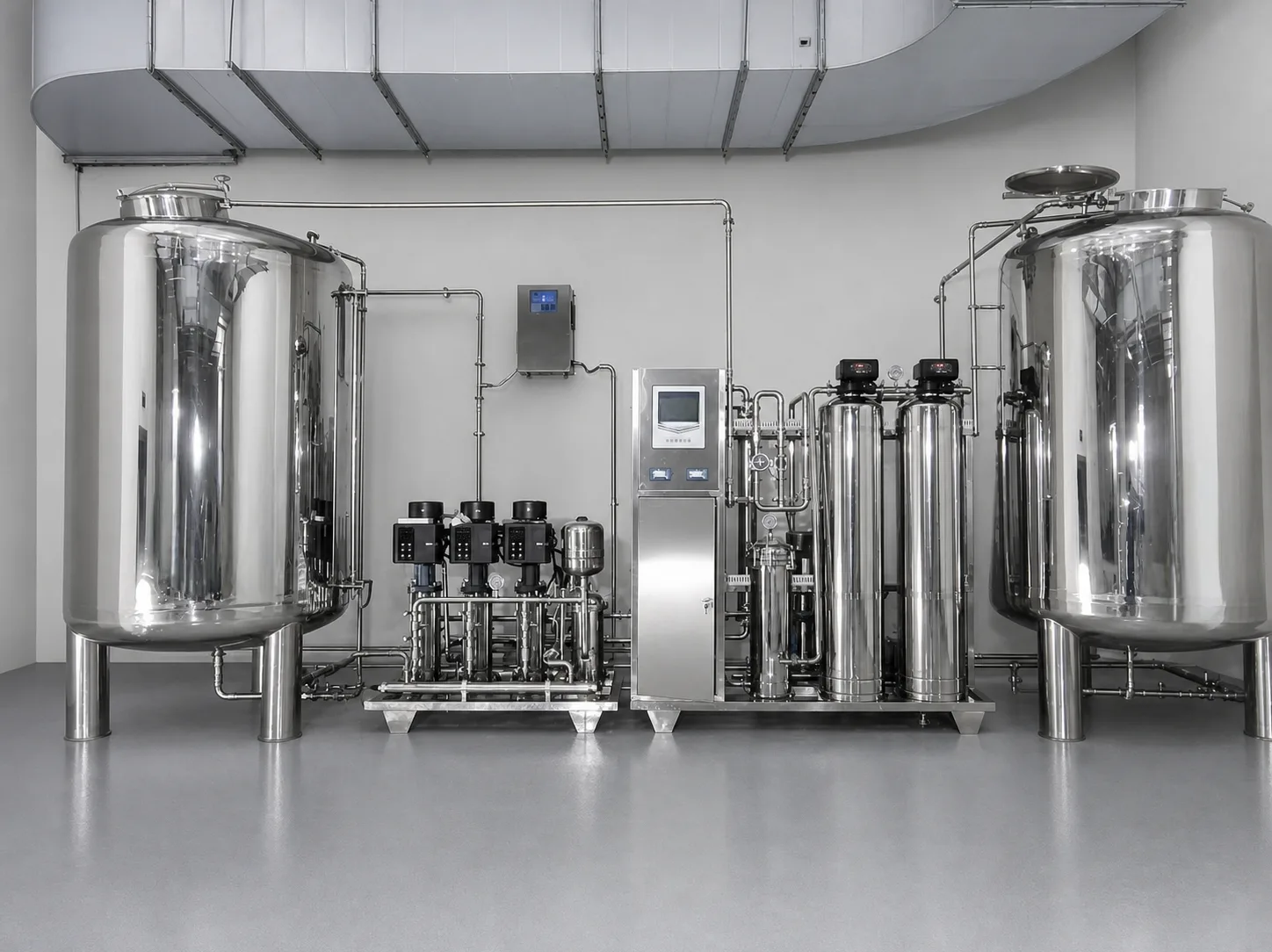
A direct drinking water system purifies municipal tap water on site through pretreatment, RO, post carbon, UV and terminal ultrafiltration, then circulates GB 5749-compliant drinking water through a constant-pressure pipe network — replacing barreled water for schools, communities, offices and factories at 0.5–50 m³/h.
KONCHEINDUSTRIAL WATER TREATMENT SYSTEMSMODEL KONCHE DW · DRINKING WATER PURIFICATIONRO + UV + TERMINAL UFHYGIENIC OPTIONSGB 5749 ORIENTEDENGINEERED BY KONCHE · 2026
QUICK TECHNICAL ANSWER
What Is a Direct Drinking Water System?
KONCHE direct drinking water systems purify municipal tap water on site and distribute it through a circulating pipe network: GB 5749 output, ≥99.99% sterilization, ≥90% salt rejection, 0.5–50 m³/h.
What it delivers
Reduces dissolved salts, organics, particles and microorganisms
≥99.99% sterilization performance under suitable conditions
Final water quality verified against GB 5749 or applicable local standards
How we scope every project
No two water sources are the same.
Each system is built from:
Source-water report (site-specific)
Served population and peak demand
Governing standard (GB 5749 or local equivalent)
The final configuration — including disinfection barriers, materials and performance guarantees — is confirmed after engineering review, not before.
Where we stand out
What matters to you
How KONCHE delivers
Regulatory compliance
Engineered to GB 5749 or your local standard — not approximated
Microbiological safety
UV + ultrafiltration as multiple barriers, not single-point protection
Hygienic operation
304/316L stainless steel supports CIP cleaning and documented system validation
No guesswork
All values on this page are reference ranges; final specs are confirmed from your water report and demand profile
A complete point-of-use drinking-water line with pretreatment, RO, post activated carbon, UV disinfection and terminal UF. The standard capacity range is 0.5–50 m³/h, with hygienic 304/316L stainless-steel options and water quality designed around GB 5749 requirements.
KONCHE drinking water systems combine pretreatment + RO + post-carbon + UV + ultrafiltration in a single, hygienic package. Standard capacities cover 0.5–50 m³/h, with 304/316L stainless-steel options for food-grade and pharmaceutical applications. Typical projects: bottled-water plants, commercial buildings and community water supply.
KEY COMPONENTS
01
Pretreatment
Removes particles and protects downstream membrane elements.
02
RO membrane
Reduces dissolved salts and improves taste and finished-water quality.
03
Post activated carbon
Improves taste and removes residual odor after RO.
04
UV sterilizer
Provides chemical-free microbial inactivation without adding residual disinfectant.
05
Terminal UF
Provides a final 0.01 μm filtration barrier at the point of use.
06
Circulating pipe network
A closed drinking-water loop keeps water fresh between the plant room and every dispensing point, preventing stagnation.
07
Constant-pressure water supply
Variable-frequency pumping maintains stable pressure and flow at all terminals, sized around peak demand.
CORE BENEFITS
Advantage
Customer benefit
Direct-drinking output meeting GB 5749
Multi-stage purification across the whole line; heavy-metal and microbiological parameters fully compliant — safe to drink directly.
Sterilization rate ≥99.99%
UV plus terminal ultrafiltration as dual disinfection, with no chemical disinfection by-products.
Multi-temperature dispensing
Ambient, warm and hot water options for tea, infant formula and direct drinking.
Point-of-use purification, no transport recontamination
Replaces barreled water — no recontamination during transport or storage, and no plastic buckets to handle.
Smart management with maintenance alerts
Filter-change reminders, online water-quality monitoring and automatic fault alarms.
TECHNICAL DATA
Parameter
Value
Model range
KCDW-0.5 to KCDW-50
Capacity
0.5–50 m³/h
Water-quality reference
GB 5749
Sterilization
≥99.99% in suitable conditions
Salt rejection rate
≥90 %
RO membrane
4040 / 8040
UV power
30–120 W, selected by flow
Terminal UF
0.01 μm
Power
220 / 380 V, 50 Hz
MODEL RANGE
Model
Capacity
Typical application
KCDW-1
1 m³/h
Small schools, community activity centres
KCDW-5
5 m³/h
Primary and secondary schools, office buildings
KCDW-20
20 m³/h
University campuses, large residential communities
KCDW-50
50 m³/h
Large enterprises, public buildings
Note: capacity and configuration of every model can be customized to actual project requirements.
APPLICATIONS
Industry
Water point
System value
Schools
Teaching-building drinking-water terminals
Safe drinking water for students and staff; replaces barreled water and cuts drinking-water cost and management effort.
Residential communities
Neighbourhood drinking-water stations
Fresh, good-tasting water dispensed by card for residents; replaces bottled and barreled water.
Office buildings
Pantry drinking-water points
Employee drinking water plus tea and coffee supply; upgrades workplace quality.
Public venues
Waiting-area drinking fountains
Safe, hygienic drinking service for travellers; reduces plastic-bottle waste.
Factories
Workshop drinking points
Safe drinking water for workers; replaces barreled water with continuous, uninterrupted supply.
MAINTENANCE
Item
Cycle
Maintenance
PP filter
Every 3–6 months
Replace according to pressure drop and source-water condition.
Activated carbon
Every 6–12 months
Replace to maintain taste and residual-organic control.
RO membrane
Every 1–3 years
Replace when product-water quality or flow cannot be recovered by cleaning.
UV lamp
Annually
Replace lamp and inspect intensity and quartz sleeve.
Terminal UF
Every 2–3 years
Replace according to pressure drop and product-water quality.
FAQ
Can the system be connected directly to a drinking-water point?
Yes. The system can be configured with hygienic storage, terminal UF and point-of-use distribution. Final verification follows the local drinking-water standard.
Does RO remove microorganisms?
RO provides a strong barrier, while UV and terminal UF provide additional disinfection and particle protection.
Can the system replace bottled water?
For schools, communities, offices and factories, local purification can reduce bottled-water procurement and storage. Capacity and distribution should be designed around actual demand.
How is the capacity selected?
Use the number of users, peak demand, operating hours and storage volume. Konche normally selects capacity around peak demand with buffer storage.
Can the produced water be drunk directly?
Yes. KONCHE drinking water systems use a multi-stage RO + UV + ultrafiltration process. The output fully meets GB 5749, the Chinese hygienic standard for drinking water quality — bacteria, viruses, heavy metals and other parameters all comply — so the water is safe to drink directly.
What are the advantages over barreled or bottled water?
The system purifies and dispenses on site, removing the recontamination risks of bottled-water transport and storage. There are no buckets to carry or store, drinking-water costs drop to roughly 30–50% of barreled water, and supply is continuous.
Does the system need a dedicated operator?
No. Fully automatic control with intelligent monitoring handles operation, flushing and filter-change alerts automatically. Only periodic filter replacement and simple inspection are needed — school or community facility staff can manage it part-time.
WHY KONCHE
01
Nearly 30 years of expertise
Since 1997, Konche has accumulated practical experience across raw-water conditions, treatment processes and industrial project delivery.
02
Professional customization
Each system is designed around the water analysis, industry standard, site condition, capacity and final use.
03
Controlled system quality
Component selection, factory testing, water-quality verification and process control are managed as one complete system.