Cloudiness or sediment in shrimp hatchery intake water raises a practical question: is the current particle-control stage adequate for the intended use? If a chemical parameter falls outside an established requirement, or a microbiological result requires action, the team must resolve that particular issue before confirming the water for its planned role. Those concerns need different responses; adding a disinfection unit does not answer every water-quality problem. For an Indonesian hatchery, begin with the difficulty affecting water use, investigate its possible cause, and then consider the appropriate treatment—including UV when disinfection is needed.
How can water-quality problems affect an intake-water decision?
A tank may hold enough water for the next filling operation, yet the water may still need treatment or further testing before use. Check whether it meets the requirements for the tanks it will supply.
Visible suspended matter makes particle control the first issue to review. A salinity, pH or ammonia result outside the site's established requirement needs a separate response to that parameter. A microbiological result requiring action raises a different question: has treatment met the required microbial-control target?
If the sampling details or acceptance limits are missing, clarify them before deciding whether the water can be used. Ask the hatchery’s water-quality lead to confirm the limits for the species, life stage and intended use.
Identify the water problem and the decision it affects
Use the table to connect a specific concern with the next operational decision. Use the last column to decide what to investigate next.
| Water-quality problem | Use or treatment decision affected | Cause or treatment direction to check |
|---|---|---|
| Visible cloudiness, suspended matter or deposits | Is existing particle control adequate before water moves to its intended use? | Review source conditions and the existing particle-control stage |
| Salinity, pH, ammonia or another measured item outside an established requirement | What response to that parameter is needed before the water can be accepted for the planned use? | Check whether the existing process addresses the item; obtain the relevant water-quality assessment |
| A microbiological result requiring action | Has treatment met the microbial-control target before use? | Review the result with the responsible specialist and assess the disinfection stage |
| Outlet and use-point results differ | Does the water still meet requirements where it will be used? | Compare samples and check the tanks and pipes between sampling points |
Verify the concern before choosing the response
For each issue, retain the result, unit, method and applicable use requirement. Mark where and when samples were taken, and whether the treatment equipment was running. Have the water-quality lead clarify any missing information before comparing results or selecting a corrective step; appearance alone cannot confirm that water meets all requirements.
Why might water still fall short after treatment?
Check these possible causes against water tests and operating records. Installed equipment may not address every problem in the incoming water.
The treatment may not address the problem. A disinfection stage does not replace particle control or correct a chemical parameter. Identify which problems the existing process leaves untreated before adding equipment.
Source conditions and pretreatment may no longer match. Compare current intake conditions with the process specification and check pretreatment operation.
Flow or UV transmittance may be outside the UV unit’s operating limits. Compare measurements with the limits in its technical documents. A lit lamp alone does not confirm that the water received the required treatment.
The issue may arise downstream. Review storage and distribution when outlet and use-point results differ. That difference alone does not prove downstream contamination.
Use the results to decide which treatment step needs attention and what further checks are needed.
Match the treatment step to the water-quality problem
Review the source and existing process before adding equipment
Review particle control, water chemistry and microbial control separately. Check existing settling or filtration for particles, ask how to address chemical parameters outside the required limits, and specify the microbial-control target.
FAO's 2007 manual for Penaeus monodon hatcheries in India discusses incoming-water treatment within wider hatchery management. For an Indonesian site, confirm local requirements and the needs of the species being raised. FAO hatchery manual.
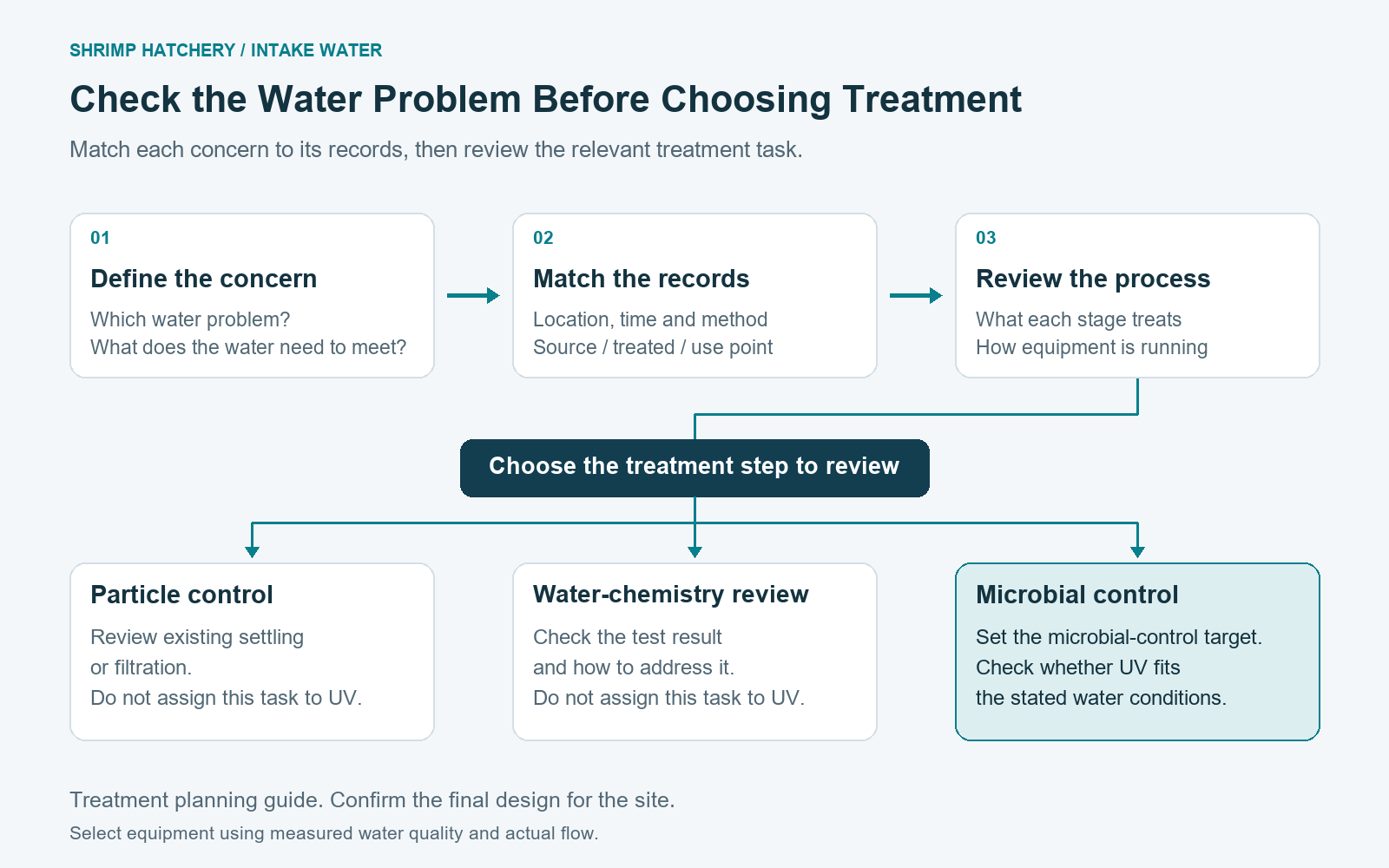
For each problem, agree who will arrange the next check or treatment step. Ask suppliers to state what their proposed equipment will address and what still needs separate treatment.
CP Prima describes filtration, ozone and UV in its Indonesian shrimp-hatchery operations. The right combination for another hatchery will depend on its water and operating needs. CP Prima shrimp hatcheries.
Where can UV help—and what does it leave unresolved?
UV can provide a disinfection step in the intake line. It should not be specified as the correction for salinity, pH or ammonia, or as a replacement for particle removal. Storage and distribution still need their own controls; UV alone cannot guarantee a disease-free hatchery.
Before discussing a model, specify where it will treat the water and the microbial-control target. Ask the supplier for performance data that apply to your flow and water quality. General background on UV water treatment systems explains common equipment arrangements; confirm performance for your site separately.
For the proposed UV inlet, obtain relevant water data, including UV transmittance where available, with its measurement details. EPA's UV toolkit addresses flow, UVT and hydraulic conditions in evaluating UV operation. The toolkit covers United States drinking-water systems. Its UV operating principles are useful background, while hatchery water requirements need separate checks. UVT alone cannot confirm that water meets all hatchery requirements. EPA UV Treatment Toolkit.
Check flow and water conditions before selecting a UV stage
A refill schedule is a starting calculation, not a reactor rating
When considering UV, distinguish the hatchery’s refill requirement from the actual flow through the proposed unit. A simple scheduling calculation is:
Average refill flow = refill volume ÷ available refill time.
The following example assumes one refill volume and two available windows. It ignores losses and demonstrates arithmetic only.
| Assumed refill volume | Assumed available window | Required average refill flow | Still to establish for equipment selection |
|---|---|---|---|
| 120 m³ | 6 hours | 20 m³/h | Actual maximum flow, inlet water data, objective and operating arrangement |
| 120 m³ | 3 hours | 40 m³/h | The same information under the shorter operating window |
Hypothetical refill example. These averages are not UV equipment ratings.
Halving the available window doubles the calculated average requirement. It does not show that a particular unit can accommodate it. Record how the pumps and filling lines actually operate, including simultaneous filling where applicable. A supplier should identify the flow condition used for selection instead of treating this average as a complete specification. See the general UV sizing inputs for background.
Keep seawater-contact conditions explicit
KONCHE can supply UV equipment in 316L stainless steel. Confirm the materials of all parts that contact water and their suitability for the site’s seawater conditions. For a proposed model, request the materials of the body, connections and seals, and provide the site's salinity, temperature, pressure and cleaning conditions for assessment. Keep any written limitations with the equipment documents.
Questions about adding UV to hatchery intake treatment
What flow and water information are needed before selecting a hatchery UV unit?
Provide the intended treatment point, actual flow conditions, relevant inlet-water reports and treatment objective. Include the operating schedule and process sketch so the information has a clear context. If data are missing, ask what must be established before selection can be completed.
Does a 316L material description establish seawater suitability?
No. Request a list of all water-contact parts and their materials for the proposed model. Ask the supplier to confirm compatibility with your operating conditions. Do not assume that seals and other components share the reactor-body material or that one material label establishes the assembly's service limits.
Can UV be evaluated within an existing filtration or ozone treatment line?
Yes. Show the existing process to the engineer or suppliers and ask them to check where and how the UV unit would connect. The overview of UV and ozone treatment principles is background, not a universal hatchery treatment recipe.
Should a shrimp hatchery specify low-pressure or medium-pressure UV first?
Specify the flow, water quality and microbial-control target first. Then compare the performance data and operating requirements of the proposed units. Information on low-pressure UV equipment and medium-pressure UV equipment can support that discussion. Neither label alone establishes the right choice for the hatchery.
What maintenance and spare-parts information should accompany a proposal?
Request service instructions, access requirements and identification of compatible UV lamps, sleeves and related components. General UV lamp replacement considerations provide context; use the proposed model's documentation for its actual service arrangements rather than assuming a universal replacement interval.
From water-test results to an equipment assessment
Once the water-quality concern is defined, bring together the test reports and sampling points, existing process sketch, actual flow and refill window, and seawater-contact and installation conditions. These details help determine whether UV fits the treatment need. KONCHE's UV water-treatment equipment page contains product, component and factory-show information; about KONCHE provides company background. To discuss equipment for your site, send your intake-water conditions to KONCHE.