Before adding UV to a shrimp farm's intake line, document the existing water route, actual flow and water quality at the proposed installation point. Then compare the proposed equipment with the pump, pipework, electrical supply, maintenance space and water-supply schedule. UV treats water passing through the equipment; it cannot make the whole farm disease-free. A useful retrofit quotation states the required flow and water quality, the connections to existing equipment and who will provide each part of the installation.
For an operating farm, the purchasing question is practical: what must change around the new equipment, and what can remain in service? A quotation that leaves those connections and responsibilities unclear is difficult to compare, even when the reactor price looks attractive.
Where would UV fit in the farm's existing intake-water system?
Begin with a sketch of the route water actually follows. Include the source, settling or storage areas, filtration equipment, pumps and distribution branches. Mark any alternative routes used during cleaning or periods of high demand. Identify the proposed UV inlet and the destination receiving water from it.
Minapoli's report on a commercial technical webinar with Yuki in November 2023 describes Banyuwangi shrimp operator Hardi Pitoyo's practice of settling intake water before using UV. Minapoli: pre-filtration and UV in shrimp farming.
Start by checking the water route at your own farm. Your existing storage arrangement, pumping sequence and cleaning practices determine which installation options deserve evaluation. The overview of UV treatment system types provides background on equipment forms; the retrofit drawing must describe the actual farm.
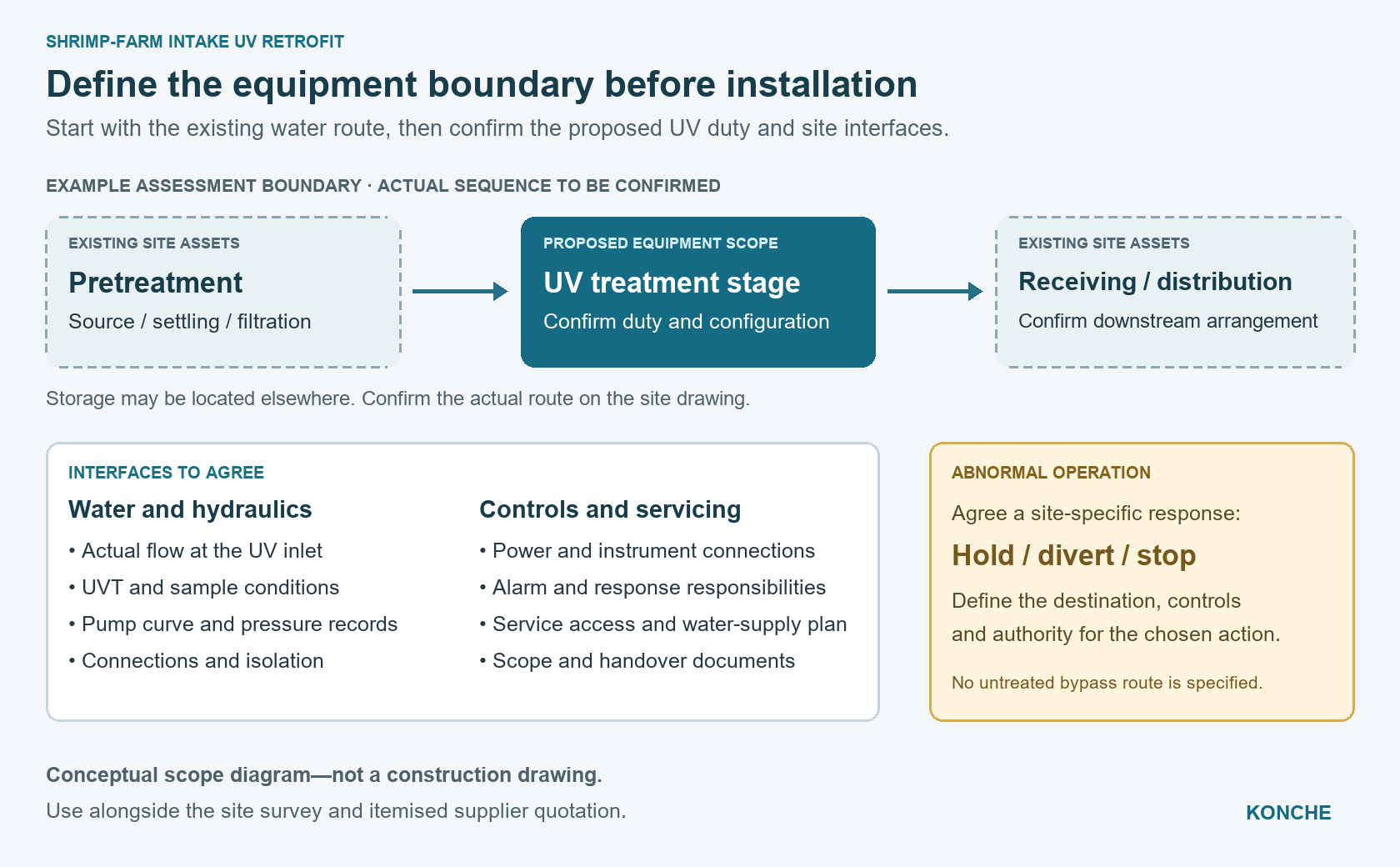
Give each existing asset a simple identifier on the sketch and use the same identifiers in photographs and quotations. A supplier should be able to distinguish the intake pump from a distribution pump without guessing. Record which sections remain operational during the proposed work, and who can confirm the drawing's accuracy.
Why can disease still occur after UV is installed?
An intake-water treatment step is only one part of farm management. If disease occurs, check how the UV unit was selected and operated, as well as other possible routes of infection. Assign people to review both the equipment records and the farm's wider biosecurity practices.
FAO's manual on Penaeus monodon hatcheries includes incoming-water management among wider hatchery practices. The manual describes Indian hatcheries; Indonesian grow-out farms need a biosecurity plan suited to their own operations. FAO: Improving Penaeus monodon hatchery practices.
For procurement, ask what operating records the proposed system will make available and which conditions the supplier's performance information covers. Agree who will review those records after installation. Ask suppliers to distinguish water-treatment performance from claims about shrimp survival, harvest output or medication use, and to provide supporting data for any such claims.
Check pretreatment performance at the proposed UV inlet
Collect water information from the proposed UV inlet, with the sampling point and operating condition identified. A source-water sample collected before settling or filtration may describe a different condition. Ask the person taking samples to record what was running and whether cleaning or backwashing had recently occurred.
EPA's UV toolkit identifies flow and UV transmittance as key conditions for assessing UV treatment. It covers US drinking-water systems, so its regulatory requirements do not apply to Indonesian shrimp farms. EPA UV Treatment Toolkit.
Make water-quality records usable in a quotation
Request a report that identifies the sample, date, location, measurement method and units. For UVT, record the wavelength and optical path length used by the laboratory. Keep turbidity and UVT as separate reported measurements rather than substituting one for the other. The supplier should state which data are still needed to select the equipment.
Describe known differences between operating periods. If water quality changes after rainfall, during a different intake period or as filters become loaded, record those observations and ask which conditions should be sampled. Give suppliers the same water-quality records so they can base their quotations on the same conditions.
If an existing treatment line includes ozone or another chemical process, identify it on the sketch. Record where it connects and the water conditions downstream. General UV and ozone treatment principles can support that discussion, but they do not specify the correct arrangement for a particular shrimp farm.
Will the existing pump and pipework support the proposed UV stage?
Record the pump identification, available pump curve, operating schedule, pipe sizes and relevant pressure and flow measurements. Ask for the proposed equipment's hydraulic information under the intended conditions. Compare the pump and UV unit's hydraulic data. Matching pipe connections alone do not show that the pump can supply the required flow through the unit.
Compare the pumping window with actual operating flow
Consider a hypothetical intake line required to deliver 240 m³ each day. Ignoring losses, average flow over the available pumping window is:
Average flow = daily water volume ÷ available pumping hours
| Assumed daily intake volume | Assumed pumping window | Calculated average flow | Information still needed for the retrofit |
|---|---|---|---|
| 240 m³ | 8 h/day | 30 m³/h | Actual operating flow, pump information, inlet-water conditions and proposed equipment pressure loss |
| 240 m³ | 4 h/day | 60 m³/h | The same information, reviewed against the shorter pumping window and available storage |
Illustrative calculation using assumed numbers. These averages are not equipment ratings or recommended design flows.
Halving the assumed pumping window doubles the arithmetic average flow required during that window. Check whether the pump and UV unit can handle that flow. Measure the flow through the reactor under the expected operating conditions, including the highest flow.
Identify whether branches run together or at different times. A daily total can conceal several operating arrangements. List which branches will run together and ask the designer to check the flow for each combination. The guide to UV sizing inputs explains what information is needed to select equipment.
Ask suppliers to quote for the same pump and piping arrangement
Give competing suppliers the same drawing and operating schedule. Request the proposed connection details, installation requirements, equipment pressure-loss information and any assumptions needing confirmation. Mark changes that affect the existing pipework or pump review as separate quotation items.
If a proposal changes the available pumping time, ask for the revised operating schedule as well. A cheaper equipment line item may simply leave more site work outside the offer. Compare the defined scopes before comparing totals.
Confirm electrical connections, controls and maintenance access
Prepare an inventory of the existing electrical supply and controls. Identify which signals already exist and which would require new instruments or wiring. Ask each supplier to distinguish equipment features included in the offer from optional items and site provisions.
Include hydraulic arrangements, maintenance access, sampling and monitoring in the installation review. EPA's toolkit also covers these practical considerations. EPA installation-review guidance.
The written scope should answer who provides isolation arrangements, electrical protection, cabling, instrument connections and any connection to the farm's existing controls. Where alarms or interlocks are proposed, ask what condition each one detects, what action follows and who can reset it. Their presence and function must be confirmed for the quoted configuration.
Define the response to a condition outside the agreed operating limits before commissioning. Whether the appropriate response is to hold water, divert it to a suitable destination or stop a feed requires a site-specific decision. Do not leave an unassessed route allowing untreated water to enter the production supply.
Check the service area as carefully as the installation footprint. Ask for the space needed to remove the relevant components, isolate the equipment and perform the specified maintenance. Include access photographs and dimensions in the supplier review. An assembly that fits between existing pipes still needs a workable servicing arrangement.
Can UV be added in stages without buying a complete new treatment plant?
You can request a quotation for UV equipment separately from a complete treatment plant. That does not establish that the existing pretreatment is adequate, or that a unit can simply be inserted wherever space is available. Use the documented flow, water quality and installation requirements to compare proposals.
A phased purchase can follow three steps: send the site information, confirm the equipment and connection requirements, then agree on installation and handover. Resolve open questions with the responsible supplier or contractor before ordering the affected items.
Separate equipment supply from site installation
When comparing low-pressure UV equipment and medium-pressure UV equipment, provide the same flow and water-quality information and ask suppliers to explain their proposals. Neither the equipment category nor lamp power alone settles suitability for the retrofit.
KONCHE can discuss UV equipment with 316L stainless-steel construction. The quotation should still identify the specific model, wetted components, seals and operating conditions requiring confirmation. That material description is not a complete assembly specification or a declaration of suitability for every seawater condition.
Assign responsibility for modifications to existing assets separately. Pipework, supports, electrical work, control integration and operational planning should not disappear inside a general description such as “complete UV system.” Require an explicit included, optional or excluded status for each relevant item.
Plan lamp and sleeve service around the farm's water supply
Ask for the maintenance instructions and spare-parts identification applicable to the proposed model. Include the lamp, sleeve, seal and other service items the manufacturer specifies. Request the conditions used to define replacement requirements, rather than accepting a generic operating-hours statement as a guarantee for the farm.
The guide to UV lamp replacement considerations provides background. Ask for a service list for the proposed model: component identification, required checks, access needs, responsible personnel and the process for obtaining compatible replacements.
Agree how water supply will be managed while the unit is isolated. The farm and its engineer should assess available storage and the acceptable service window. Do not assume that taking one unit out of service permits untreated water to bypass the planned treatment step. Record the agreed operating arrangement in the handover documents.
Ask for the checks required before returning the equipment to service after maintenance. Keep a record of the work, components replaced and any unresolved observations. When ordering UV consumables and components, identify the supplied model and confirm availability and delivery time.
Use a retrofit scope and handover checklist
Use this checklist to agree who supplies and installs each item. Add the responsible company or person and the relevant drawing, quotation or procedure. Confirm site works separately from equipment supply.
| Item | What is already on site | What the supplier provides | Contractor or buyer responsibility | Documents to check |
|---|---|---|---|---|
| Pretreatment | Record current assets and condition | Confirm interface requirements | Assign any assessment or upgrade | Process sketch and inlet-water records |
| Pump and pipework | Identify pump, branches and valves | Confirm connection and hydraulic information | Assign modifications and engineering review | Pump records and interface drawing |
| UV assembly | Identify proposed location | State model and included components | Confirm receiving and installation arrangements | Itemised quotation and drawings |
| Supports and access | Record available space | Supply applicable access requirements | Assign supports, access and isolation work | Dimensions and site photographs |
| Instruments and controls | List existing signals and controls | Identify included and optional functions | Assign wiring, integration and response logic | Instrument list and control description |
| Electrical supply | Document available supply | State equipment requirements | Assign site electrical work | Electrical scope and connection details |
| Service window | Describe storage and supply constraints | Provide applicable service information | Agree the operational arrangement | Maintenance and water-supply plan |
| Handover | Identify operating personnel | Specify supplied documentation | Agree checks, records and responsibilities | Signed scope and handover checklist |
Before placing the order, also identify what the supplier will provide for commissioning and what the site must arrange. Ask how measured conditions and equipment records will be documented at handover. Acceptance should refer to the agreed specification and evidence, rather than a general statement that the lamp illuminates or water appears clear.
KONCHE's UV water-sterilizer product page shows equipment, components and factory information. The KONCHE company page provides further business information.
To begin an equipment discussion, send KONCHE your intake-line retrofit information: the existing process sketch, proposed UV-inlet water records, flow and pumping schedule, pump and pipework details, photographs of the available space and a list of the work you need. Ask for a quotation that clearly lists supplied equipment, site work and details still to be confirmed.
Shrimp-farm UV retrofit questions
Does installing UV make the whole farm disease-free?
No. UV treats water that passes through the equipment. The farm still needs wider biosecurity measures. If disease occurs, investigate the equipment's operating records alongside animal-health information and other possible sources of infection.
Can a supplier select a UV dose from pond volume alone?
Pond volume does not describe the full intake treatment duty. Ask what flow, UVT, target-organism and performance evidence the proposal requires. The scheduling calculation above only illustrates average water delivery; it does not calculate dose or establish a model's treatment capacity.
Does an intake-water UV retrofit mean placing lamps in stocked ponds?
This guide concerns a defined UV stage in the intake-water treatment route. It does not recommend exposing stocked ponds or animals to lamps. The proposed equipment location, hydraulic route and downstream receiving arrangement should appear on the project drawing.
Can the UV stage be evaluated separately from a complete treatment-plant purchase?
Yes. Ask for a separate quotation for the UV equipment and its installation requirements. Check the existing pretreatment, flow, water quality and operating schedule before ordering, and identify any other work needed.
What should the quotation say about replacement lamps and maintenance?
It should identify compatible service parts, applicable maintenance instructions, access requirements and the responsibilities for isolation and return to service. Ask which information is model-specific and what replacement conditions apply. Confirm supply arrangements separately rather than assuming local stock or a universal lamp-life figure.