A seawater RO plant's chemical system should be selected from its water quality, treatment design and operating conditions. Capacity determines how much water the system handles; it does not, by itself, decide which chemicals are necessary or their dose. A compact plant can justify a simple arrangement when the required protection functions are covered. A larger flow increases chemical throughput; monitoring and continuity requirements still depend on the process and site.
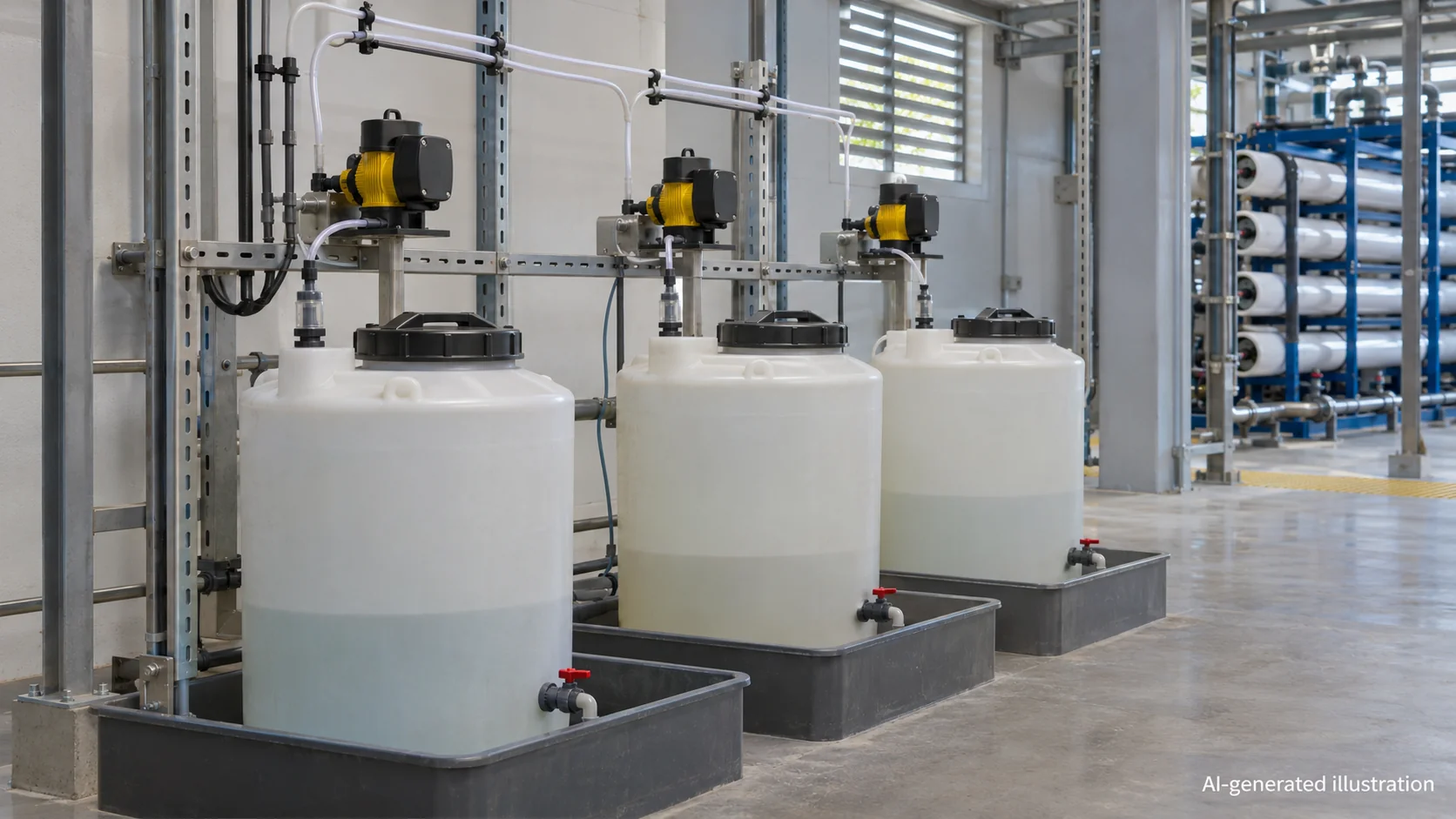
This distinction matters when comparing a small boat watermaker, an island supply unit or a factory installation. Removing unnecessary complexity can make operation easier. Removing a function that the membrane design depends on can leave the equipment operating outside its intended conditions.
Can a small seawater desalination plant omit chemical dosing?
Sometimes a treatment design can omit a particular chemical stage. Plant size alone is not the evidence for doing so.
The decision starts with the intake water and the proposed membrane operating conditions. Scale formation, suspended material, biological fouling and oxidant exposure are different problems. A clear-looking seawater sample does not answer all four, and intermittent operation does not automatically remove them.
For a small installation, the useful question is: which protection functions does this design require, and how will each be delivered reliably? The answer may involve treatment equipment, an appropriate chemical programme, operating limits or a combination. “Small plants do not need chemicals” and “all seawater plants need the same chemicals” both skip this design work.
If the source itself is uncertain, first resolve the difference between seawater and brackish-water RO. A dosing schedule copied from a different feedwater source is a weak starting point for either system.
Separate the chemical functions before selecting equipment
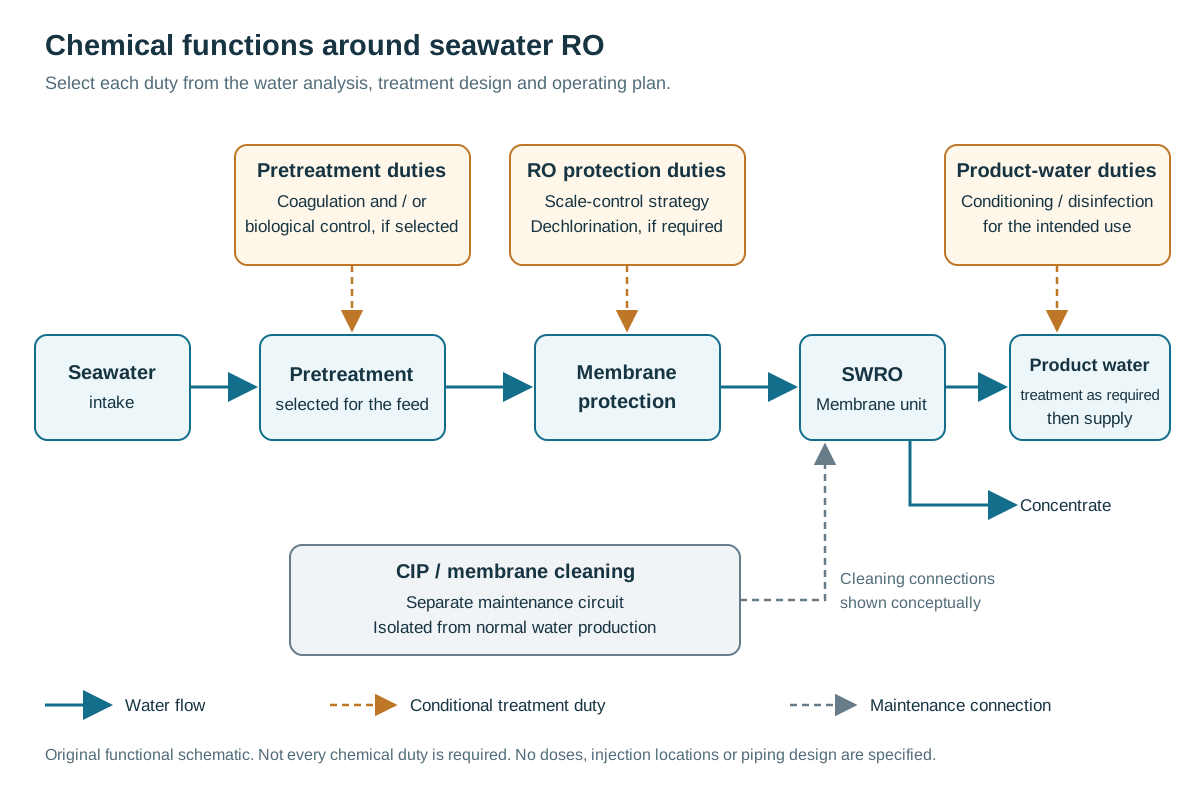
Chemical tanks can look similar while serving completely different purposes. The following matrix is a way to define the treatment functions; it is not a list of chemicals that every plant must use.
| Function | Purpose | What determines whether it is needed? |
|---|---|---|
| Coagulation or coagulation assistance | Support particle and colloid removal in a suitable pretreatment process | Raw-water characteristics and the selected pretreatment arrangement |
| Biological control | Manage biological fouling within the treatment system | Intake conditions, process design and compatibility of the selected treatment |
| Dechlorination | Remove oxidant exposure that is incompatible with the RO membranes | Upstream treatment and the limits of the installed membranes |
| Scale control | Manage precipitation risk as the feed becomes concentrated | Water chemistry, recovery and the selected scale-control strategy |
| Chemical cleaning | Remove identified deposits from membranes during a cleaning procedure | Performance trends, foulant diagnosis and the applicable cleaning instructions |
| Product-water conditioning or disinfection | Prepare treated water for its intended use and distribution | Final water-quality requirements and the downstream system |
The RO/NF technical manual treats scale control, particulate removal and biological control separately. This separation should remain visible in the equipment design. A coagulant does not become a substitute for a biocide because both are supplied through a metering pump.
The SWRO components guide places these functions within the wider treatment train. For procurement, each dosing unit should have a defined duty, rather than simply adding to the number of tanks in the quotation.
Scale control needs a calculation, not a capacity-based dose table
RO removes product water while retaining much of the dissolved salt in the concentrate stream. The scale-control assessment therefore has to consider concentrate conditions, not just the salinity written on the feedwater report.
A suitable assessment connects the ionic analysis with the proposed recovery and operating conditions. Where an antiscalant is selected, its suitability and dose must correspond to that assessment and the chemical supplier's recommendations. The technical basis is set out in the manual's scale-control sections.
This leads to two practical conclusions. First, a small plant is not exempt from scale assessment. Second, a larger plant does not automatically need a higher concentration of antiscalant simply because it produces more water.
There is a useful distinction between dose concentration and chemical consumption. At the same validated concentration, more feedwater requires more chemical mass. The relationship is proportional:
| Relative feed flow | Same validated dose concentration | Relative chemical mass required per hour |
|---|---|---|
| 1 × Q | C | 1 × M |
| 2 × Q | C | 2 × M |
| 5 × Q | C | 5 × M |
Q, C and M are reference quantities, not proposed operating settings. This table expresses arithmetic only. Actual metering-pump flow also depends on the prepared solution concentration and its properties.
The table explains why metering capacity and refill demand can increase without changing the required dose concentration. It does not prove that different plants should use the same concentration: their chemistry and recovery may differ.
For a buyer reviewing a seawater desalination system, the meaningful deliverable is a scale-control basis tied to the proposed design. A generic “seawater antiscalant” label is not that basis, and a product name alone cannot establish compatibility.
Chlorination and membrane protection must be designed together
Biological control in pretreatment and oxidant protection at the membrane inlet are connected decisions. When upstream chlorination is used with chlorine-sensitive membranes, the design must address removal of the incompatible residual before it reaches them. It must also define how that protection is checked.
This is why a chlorination tank should not be evaluated in isolation from the downstream treatment and monitoring. Equally, omitting upstream chlorination does not establish that biological fouling has been solved. The alternative strategy still needs to suit the intake, the process and the installed membranes.
Non-oxidizing biocides are not a universal shortcut. Their suitability, use pattern and discharge or product-water implications depend on the selected chemistry and application. A weekly soak or continuous dose should not be copied from a general article into an operating procedure.
Chemical names also deserve care. SMBS means sodium metabisulfite, Na₂S₂O₅; SBS means sodium bisulfite, NaHSO₃. They are related but are not the same chemical identity. The dechlorination section of the technical manual describes their relationship. Procurement records should identify the supplied product and concentration, so an abbreviation does not become an assumption about an interchangeable dose.
Membrane cleaning belongs in the maintenance plan
Cleaning chemicals serve a different role from chemicals metered during normal production. Clean-in-place, or CIP, means cleaning the installed membrane system through a defined procedure; it does not mean continuously adding cleaning solution while producing usable water.
The cleaning decision should follow the applicable membrane instructions and performance trends. Normalized data help distinguish changes caused by operating conditions from deterioration that needs investigation. The technical manual's cleaning guidance uses normalized performance criteria, rather than declaring one monthly cleaning interval suitable for every plant.
For the equipment package, this means planning the cleaning connection points, equipment, chemical compatibility and operating responsibility before service begins. The selected cleaning method must address the identified fouling; simply keeping acid and alkaline chemicals on site does not establish a suitable cleaning procedure. The SWRO membrane maintenance guide covers the broader maintenance decision.
Flushes, chemical cleaning and preservation during an extended shutdown should also remain distinct in the operating plan. Combining them under a vague “automatic cleaning” feature makes it difficult to understand what the supplied system actually does.
How should small, medium and larger installations differ?
Plant size changes practical requirements such as chemical throughput, storage and the consequence of an interrupted dose. The operating environment matters just as much. A small remote unit with infrequent attendance may need more attention to refill arrangements and fault response than a larger installation with experienced staff nearby.
Use the following scenarios to decide what simplification means:
| Project situation | A sensible design priority | An unsafe purchasing assumption |
|---|---|---|
| Small, intermittently operated unit | Keep the arrangement understandable while retaining every required protection function | Intermittent operation makes scale or biological control unnecessary |
| Factory with sustained water demand | Match chemical delivery, monitoring and maintenance arrangements to the required operating schedule | A fixed number of dosing tanks proves the package is complete |
| Remote island or coastal site | Match refill needs, chemical availability and fault response to local support | Automation removes the need for consumables and trained intervention |
| Larger or multiple-train installation | Coordinate duties, chemical distribution and service arrangements across trains | Every chemical must be installed solely because total capacity is high |
For containerized treatment equipment, chemical servicing must fit the actual layout. Compact packaging should still allow operators to identify the correct unit, inspect it and carry out the specified maintenance. The presence of an enclosure does not resolve these working arrangements by itself.
Keep product-water treatment separate from membrane protection
A chemical programme that protects the RO system does not, by itself, define the quality of water delivered to the user. Factory process water and water intended for drinking may have different downstream requirements.
Product-water conditioning and disinfection should therefore follow the intended use, storage and distribution design. The guidance on safe drinking-water from desalination considers source water, treatment and subsequent water management together. It is not a reason to add a drinking-water chemical train to every industrial application.
Keep these downstream duties separate in the process description. Membrane-inlet dechlorination and product-water disinfection can both appear in one project because they act at different locations for different purposes. Neither should be deleted simply because the other is present.
Turn the required functions into an operable chemical system
The final design should connect each selected treatment function to its chemical identity, validated operating basis, dosing equipment, monitoring and maintenance instructions. That connection is what makes the arrangement usable by the people who will operate it.
For a purchasing team, three unresolved items deserve attention before ordering: a chemical duty without a design basis, a required duty without an assigned piece of equipment, or a dosing unit without a workable refill and service arrangement. Addressing these gaps is more useful than counting tanks or comparing an unsupported list of dose values. The commercial desalination buying guide explains how this fits into the wider equipment purchase.
KONCHE has an operating seawater desalination installation serving a factory in Indonesia, with 20 T/H freshwater output and energy recovery. This application reference does not specify its chemical programme or establish a dosing schedule for another site.
For a project-specific proposal, send KONCHE the feedwater analysis and operating requirements, together with the required product-water quality and the site arrangements for chemicals and maintenance. The objective is a chemical system that covers the actual treatment duties and can be operated consistently at your site.
Frequently asked questions about SWRO chemical dosing
Is antiscalant mandatory in every seawater RO plant?
The design needs a justified scale-control strategy. Whether a particular antiscalant is required, and at what dose, depends on the chemistry and operating design. Plant capacity alone cannot answer that question, and existing dosing should not be removed without reassessing the design basis.
Does a sand filter make coagulant dosing compulsory?
The filter's presence is not enough to establish that requirement. Coagulation must suit the raw-water conditions and pretreatment process. It also has to be compatible with downstream treatment. A generic equipment list cannot replace that assessment.
Can a biocide replace a coagulant in a compact system?
No. They address different functions. Simplification should remove an unnecessary stage or provide a justified alternative for its duty; swapping chemicals that solve different problems does neither.
Should cleaning chemicals run through the membrane all the time?
No. Membrane cleaning is a defined maintenance procedure, separate from normal production dosing. Its chemistry and timing should follow the installed membrane's instructions and the condition being addressed.
Is a more automated dosing system always the better choice?
Automation is useful when it supports a defined operating need and a practical response to faults. It does not establish that the selected chemicals are appropriate, keep storage tanks supplied or replace maintenance. Compare the complete operating arrangement, rather than automation features alone.