A seawater reverse osmosis plant can run around the clock when its equipment, treatment process and site services are designed for that duty. That does not mean every desalination machine is suitable, or that one treatment train can supply water without ever stopping. Continuous water supply requires a plan for maintenance as well as production. For a factory, island facility or coastal project, the useful question is how the required water reaches the user while equipment operates, stops and returns to service.
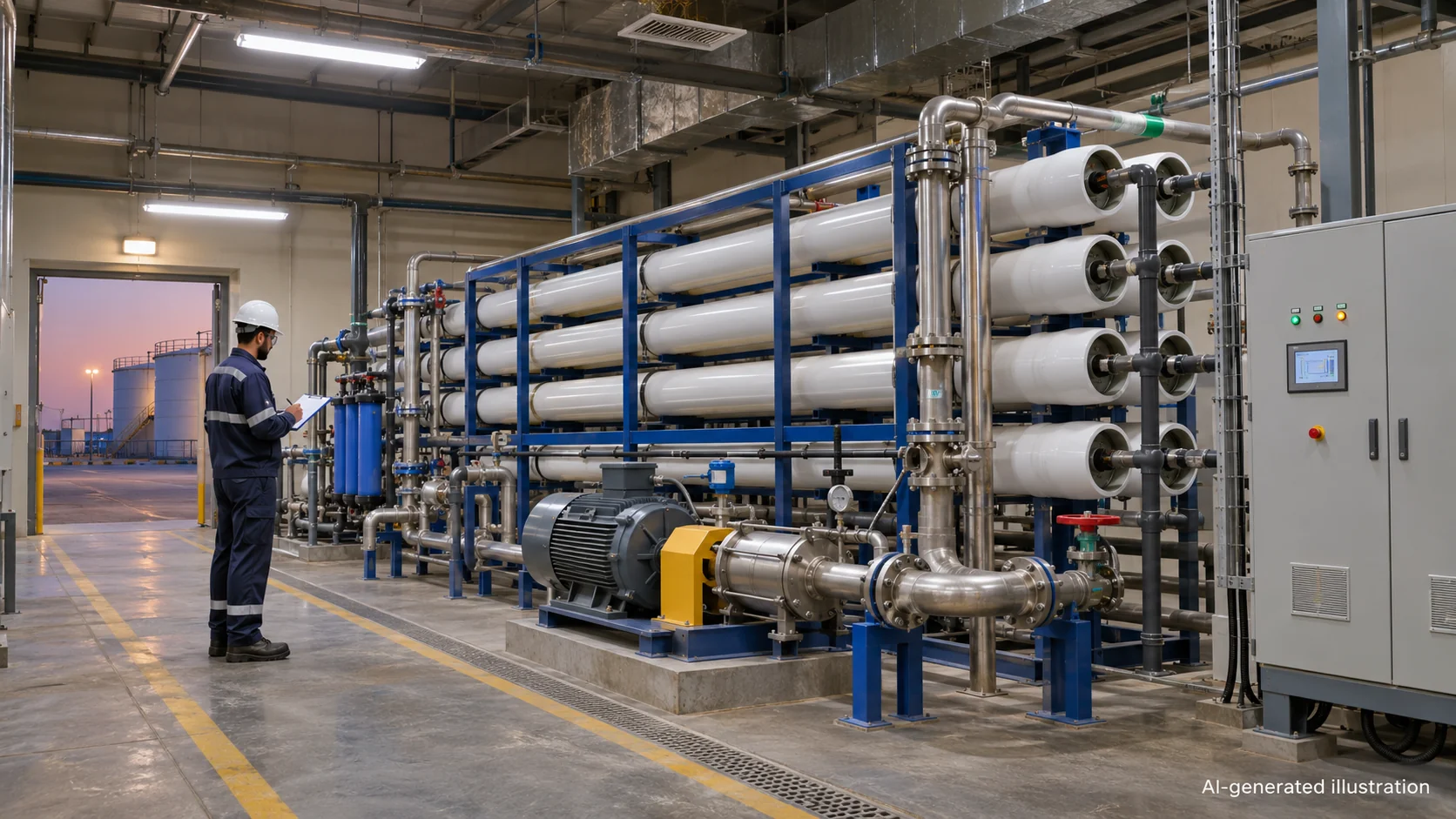
Continuous operation and continuous water supply are different requirements
Three requirements often become confused in an enquiry. The first is equipment duty: whether pumps, motors, electrical systems and other components can operate for the intended duration under the specified conditions. The second is process availability: whether intake, pretreatment, RO and downstream treatment can remain available together. The third is continuity at the water user, including the periods when treatment is unavailable.
A continuous-duty pump addresses part of the first requirement. It does not solve a blocked intake, a pretreatment service interruption or a membrane cleaning shutdown. A product tank can separate water production from water use, but only for as long as its usable reserve covers demand.
This distinction should shape the seawater desalination system specification from the start. A factory that cannot interrupt production needs a defined supply arrangement during maintenance. A seasonal camp may accept scheduled production and storage. Both can use seawater RO; they need different operating plans.
How much more water does a 24-hour schedule produce?
At an unchanged hourly production rate, longer operation produces more water in direct proportion to the hours worked. The arithmetic is simple; the availability assumptions are what need care.
The table uses a 20 T/H freshwater mass-flow rate and hypothetical daily operating hours. It does not represent measured daily output from a particular installation.
| Assumed production hours per day | Calculation | Theoretical freshwater production |
|---|---|---|
| 12 | 20 tonnes/hour × 12 hours | 240 tonnes/day |
| 16 | 20 tonnes/hour × 16 hours | 320 tonnes/day |
| 20 | 20 tonnes/hour × 20 hours | 400 tonnes/day |
| 24 | 20 tonnes/hour × 24 hours | 480 tonnes/day |
Moving from 16 to 24 hours increases theoretical output by 50%, provided the hourly rate stays unchanged. These figures use tonnes throughout, without converting them into cubic metres. Actual water available to the user must account for interruptions, water not released for use and any water consumed within the treatment system.
A schedule that needs every available hour to meet ordinary demand leaves no time allowance for lost production. Storage can bridge a stop, but the plant also needs a way to replenish that reserve afterwards. If normal demand already consumes all achievable production, a larger tank alone cannot correct the ongoing shortfall.
This is why the required daily supply, demand profile and maintenance allowance belong alongside the hourly capacity in a desalination equipment purchase specification.
Choose the operating schedule around demand, not a universal rule
Long production runs can suit a stable, substantial water demand. Scheduled operation can suit a smaller or variable demand when storage and the permitted shutdown procedure support it. Neither 16 nor 24 hours is a universal optimum.
| Project situation | Operating approach to evaluate | Condition that decides whether it works |
|---|---|---|
| Factory or occupied island facility with demand throughout the day | Long production runs with planned maintenance coverage | Water remains available during a treatment interruption |
| Site with demand concentrated in defined working hours | Scheduled production matched to demand and storage | Production windows provide enough water and allow reserve recovery |
| Seasonal or intermittently occupied site | Planned operating campaigns and a documented shutdown procedure | The equipment is correctly shut down, protected and restarted |
| Process that cannot tolerate loss of water | Storage, alternative supply or an appropriate standby arrangement | The remaining supply can cover the specified interruption scenario |
Running longer is not automatically more energy efficient. Compare electricity use per unit of acceptable water under equivalent feed and product conditions. A reduced production rate is only useful if the resulting operating point remains within the system's permitted limits. More starts, fewer starts or a lower pump speed cannot, on their own, establish the lowest operating cost.
Establish the permitted operating conditions before extending the hours
The first step towards longer runs is confirming that the complete system supports them. The SWRO component selection guide explains the functions involved; the operating plan needs to connect those components into one supported duty.
For pumps and electrical equipment, check the specified duty, loads, cooling conditions and service requirements. For the treatment process, confirm the permitted feed conditions, flow range, recovery and pressure limits. For the site, establish the availability of intake water, power, pretreatment and the required chemicals or consumables.
Operating pressure and recovery are design variables, not settings determined by the length of the working day. Membrane performance changes with feedwater and operating conditions, as explained in the RO technical overview. Increasing pressure to compensate for declining production without investigating the cause can conceal an unresolved problem.
Protective functions also need a defined response. The operating procedure should explain what happens when feed supply is inadequate, product water is outside its specification, a tank reaches its operating limit or equipment trips. An alarm that nobody receives is not an effective operating arrangement. Automatic controls support the operator; they do not remove the need for inspection and response.
Monitor trends before a production loss becomes a supply problem
A single pressure reading cannot describe the condition of an RO plant. A useful operating log links water quality, flow, pressure and equipment condition at the same time, so that changes can be interpreted together.
| Information to record | What the operator should examine |
|---|---|
| Feed temperature and water-quality measurements | Whether changing feed conditions explain a performance change |
| Feed, product and concentrate flows | Whether production and recovery remain within the approved operating basis |
| Pressures and differential pressures across relevant stages | Where a changing pressure loss or operating condition is occurring |
| Product-water conductivity or other specified quality measurement | Whether water remains acceptable for its intended use |
| Tank levels, trips and operating hours | Whether the production schedule is keeping up with demand |
| Pretreatment condition, chemical availability, leaks and cooling | Whether supporting equipment is ready for continued operation |
Membrane performance should be compared on a consistent basis. Normalization adjusts relevant performance data for changing conditions, helping distinguish those effects from deterioration. The RO operation and maintenance manual addresses normalized performance in Section 5.6.6 and cleaning criteria in Section 6.3.
Use the installed equipment's instructions to define inspection frequency, alarm limits and corrective actions. A persistent change needs investigation rather than a higher pressure setting simply to restore the displayed output. When alarms occur, the log should help the responsible operator distinguish a feedwater change, pretreatment problem, instrument issue or membrane performance concern.
Plan flushing, cleaning and service as different activities
Continuous-duty equipment still needs maintenance. The appropriate question is what work stops production, how long that work may take and what supplies the user during it.
Shutdown flushing follows the system's specified shutdown procedure. Chemical cleaning, often called cleaning in place or CIP, addresses suitable membrane deposits using an approved process. Preservation protects equipment or membranes during a shutdown where that procedure is required. These activities have different purposes; performing one does not automatically replace the others.
The membrane manual bases cleaning decisions on performance criteria, rather than prescribing one calendar interval for every installation. Its guidance must be applied within the limits of the installed membrane and system. The membrane cleaning and replacement guide provides further context for planning this work.
Pretreatment requires its own service plan. Filter inspection, cleaning or backwashing should follow the installed process and its operating condition. A site cannot assume that one pretreatment train remains available while it is being serviced. Record which tasks interrupt RO feed and coordinate them with storage or another available supply.
Mechanical and electrical maintenance must also be included. Pump service, cooling-system attention and instrument checks are not eliminated by automatic operation. Keeping suitable consumables and service items available can make a planned intervention easier to organize; the required inventory should reflect the installed equipment and replenishment arrangements.
Keep water available while a treatment train is stopped
The following diagram separates production from supply. It shows planning functions, not the piping or confirmed configuration of a KONCHE installation.
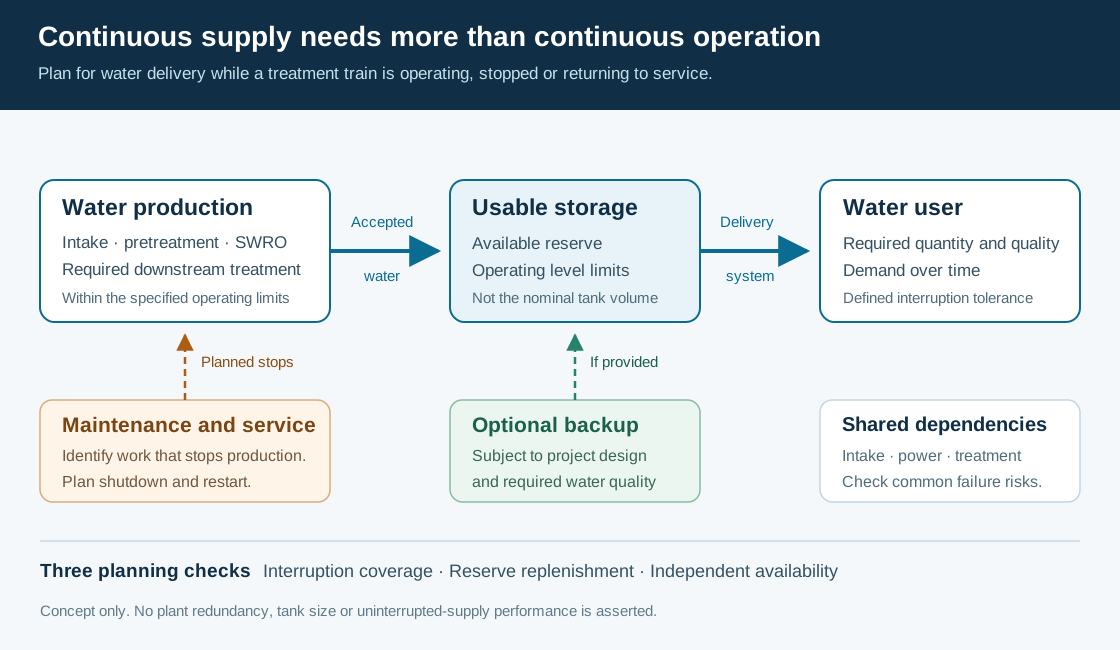
For a defined interruption, compare the usable stored water with demand during that interruption. Consider the level at which the stop begins, the reserve that must remain unavailable for ordinary use, and the time needed to restore acceptable production. Tank volume printed on a drawing is not necessarily the usable reserve.
Where storage alone is insufficient, evaluate an alternative supply or an appropriate standby arrangement. Check shared dependencies: a standby RO train supplied by the same failed intake or electrical source may not cover that failure. The purpose is to address a defined interruption, not simply to add another machine.
For Saudi coastal projects, include actual ambient conditions and the equipment enclosure in this assessment. Cooling and maintenance access deserve explicit attention in enclosed installations; the containerized plant selection guide discusses those layout considerations. An enclosure does not, by itself, establish continuous operating capability.
Apply the operating plan to the actual project
KONCHE has an operating seawater desalination installation serving a factory in Indonesia, with 20 T/H freshwater output and an energy recovery device. This application reference does not establish a measured 24-hour operating record or annual availability figure. A new project's continuous-supply commitment needs its own design and operating basis.
To discuss a new installation or an extended operating schedule, send KONCHE the water demand and site conditions. Include the required daily quantity and quality, hourly demand pattern, available storage, allowable interruption and available feedwater information. For an existing system, add the operating log and installed equipment details. These inputs turn “24-hour operation” into a supply requirement that can be evaluated.
Frequently asked questions
Does a 24-hour rating mean the plant can operate all year without stopping?
No. A stated duty must be read with its operating conditions and maintenance requirements. Continuous supply over a year also needs an arrangement for planned service and relevant unplanned interruptions.
Is it better to run for 16 hours or 24 hours each day?
Choose the schedule that meets demand within the permitted operating range and leaves a workable maintenance and reserve-recovery plan. Neither schedule is inherently best for every site, and energy performance needs a like-for-like comparison.
Should the plant be stopped every week for membrane cleaning?
There is no universal weekly cleaning rule. Follow the installed system's operating instructions and applicable performance-based criteria. Shutdown flushing, chemical cleaning and preservation are separate procedures.
Can a larger product tank guarantee uninterrupted supply?
Only for interruptions that the usable reserve and distribution system can cover. The operating plan must also provide enough subsequent production to replenish that reserve. Storage cannot make up a permanent production deficit.
Does automatic operation remove the need for an operator?
No. Controls can monitor conditions and execute specified actions, but inspection, replenishment, maintenance and alarm response still need an assigned owner. The appropriate staffing and response arrangement depends on the site and equipment.