How to Select an Industrial RO System: Capacity, Feed Water & Application
A buyer’s guide to capacity, feed water, application, pretreatment, components, controls and project quotations.
A comparable industrial RO quotation begins with the same design basis for every bidder: source-water analysis, net product-water demand, point-of-use quality, operating schedule, equipment preferences and the project supply boundary. This guide uses all five supplied RO reference images to show what to confirm and which pictured claims still need project conditions.
Review Your RO Requirement ↗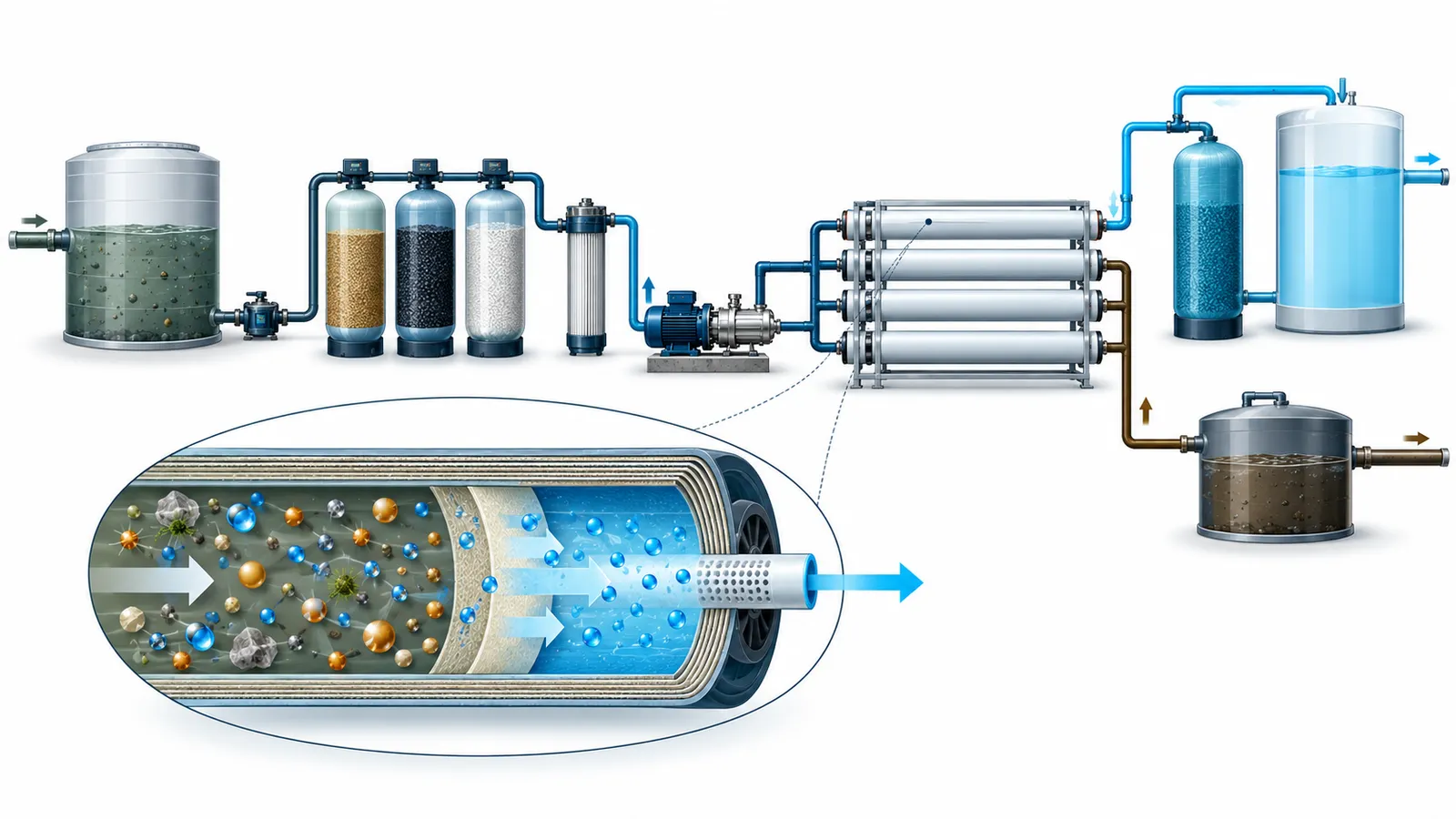
What Determines the Right Industrial RO System and Project Quote?
Give every supplier the same feed-water report, required net product flow, point-of-use quality, operating schedule, component preferences and site scope. Compare the proposed pretreatment, membrane and pump selection, wetted materials, instruments, automation, consumables, warranty and acceptance conditions. Treat rejection percentages, outlet TDS, membrane life and continuous-supply statements as conditional until their design basis is written into the quotation.
Industrial RO Selection Checklist
- Application and treated-water target
- Process-water quality requirements
- Capacity and operating schedule
- Feed-water analysis
- Pretreatment duties
- Membrane selection and replacement
- Materials and pumps
- Quotation component schedule
- Flow, pressure and automation
- Industrial RO RFQ checklist
- Cost, application and selection questions
Related: industrial RO equipment · how industrial RO works · single-pass versus double-pass RO
Which Industrial RO System Fits Your Application and Treated-Water Target?
Industrial reverse osmosis can reduce dissolved salts and many other substances, but a sentence such as “removes up to 99%” is not a complete equipment specification. The result depends on the constituent, membrane, feed chemistry, pressure, temperature, recovery, pretreatment and membrane condition. Ask the supplier to state which parameter is being reduced, the design feed used and where the treated-water result will be verified.
The supplied RO selection reference identifies the following application groups. The table keeps every application while separating the role of RO from the final-water obligation.
| Application group | Examples in the supplied reference | What the buyer must define |
|---|---|---|
| Food and beverage | Bottled water, juice and dairy production water | Ingredient or process-water specification, hygiene controls, storage and final acceptance point. |
| Medical, pharmaceutical and laboratory | Injection-water and laboratory-ultrapure-water treatment trains | RO may be an upstream step. Final polishing, microbial control, distribution and the applicable method or standard must be specified separately. |
| Electronics | Chip cleaning and display-panel manufacturing | Required conductivity or resistivity plus any silica, TOC, particle and microbial limits at the point of use. |
| Commercial and institutional drinking water | Hotels and schools; the source also mentions household systems | This guide addresses centralized B2B equipment. Drinking-water projects must define source water, post-treatment, protected storage and the applicable local requirements. |
| Industrial utility and reuse | Boiler make-up and electroplating wastewater reuse | Boiler pressure or process rinse point, reuse-stream variability, concentrate route and downstream treatment. |
For the process itself, use the industrial RO process guide. For the membrane arrangement, use the single-pass versus double-pass guide. This page focuses on what an engineering contractor or plant owner should send, compare and confirm before ordering equipment.
What Treated-Water Quality Does Your Process Require?
The supplied reference lists conductivity or resistivity examples for 15 process points. Its data have been extracted, translated and rebuilt as the English decision graphic below, followed by a searchable table. These values are planning references from the supplied material. They are not universal industry standards, do not replace a project specification and do not prove that RO alone will achieve the result.
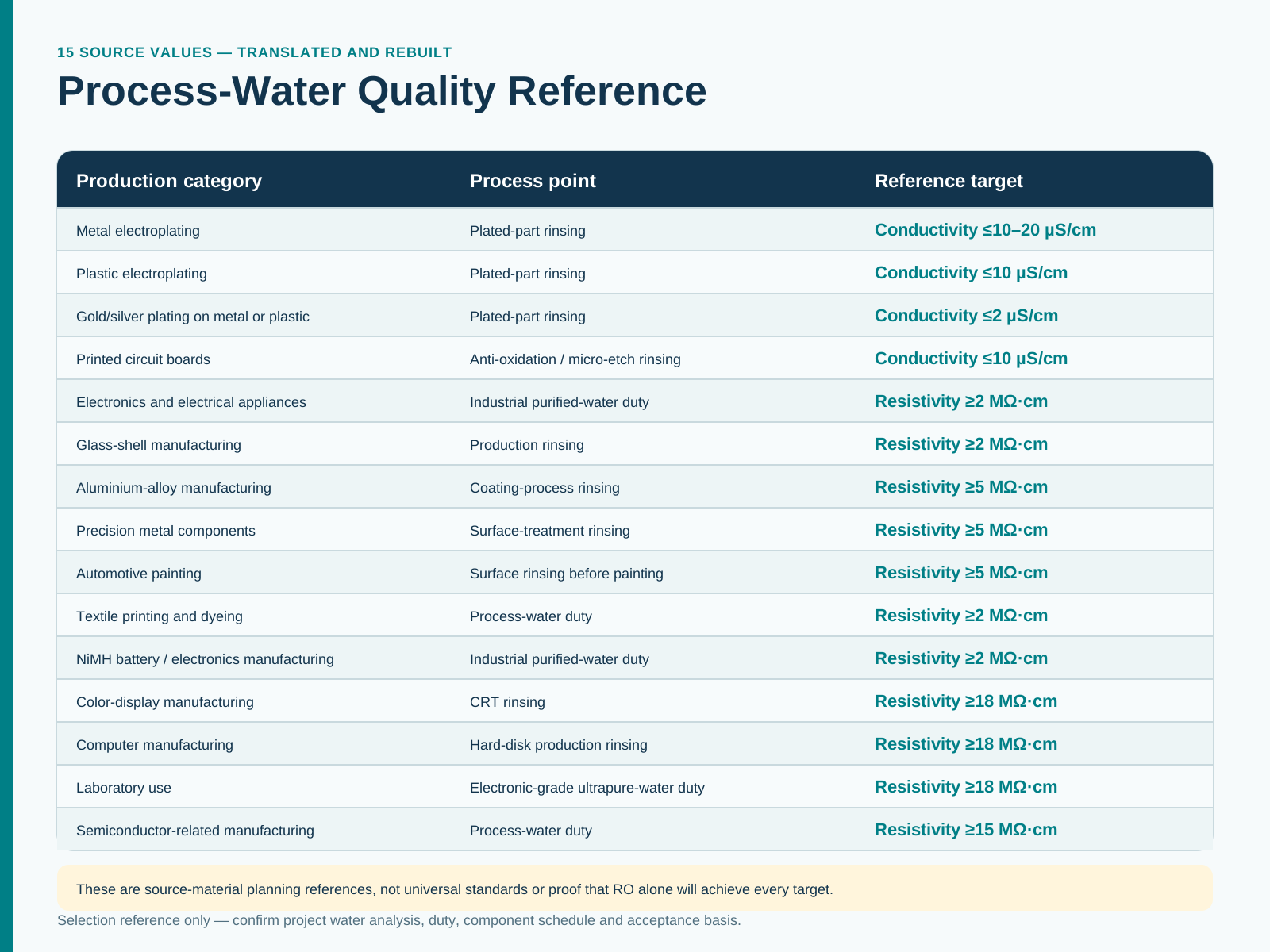
| Production category | Process point | Reference in supplied image |
|---|---|---|
| Metal electroplating | Plated-part rinsing | Conductivity ≤10–20 µS/cm* |
| Plastic electroplating | Plated-part rinsing | Conductivity ≤10 µS/cm |
| Gold/silver plating on metal or plastic | Plated-part rinsing | Conductivity ≤2 µS/cm |
| Printed circuit boards | Anti-oxidation / micro-etch rinsing | Conductivity ≤10 µS/cm |
| Electronics and electrical appliances | Industrial purified-water duty | Resistivity ≥2 MΩ·cm |
| Glass-shell manufacturing | Production rinsing | Resistivity ≥2 MΩ·cm |
| Aluminium-alloy manufacturing | Coating-process rinsing | Resistivity ≥5 MΩ·cm |
| Precision metal components | Surface-treatment rinsing | Resistivity ≥5 MΩ·cm |
| Automotive painting | Surface rinsing before painting | Resistivity ≥5 MΩ·cm |
| Textile printing and dyeing | Process-water duty | Resistivity ≥2 MΩ·cm |
| NiMH battery / electronics manufacturing | Industrial purified-water duty | Resistivity ≥2 MΩ·cm |
| Color-display manufacturing | CRT rinsing | Resistivity ≥18 MΩ·cm |
| Computer manufacturing | Hard-disk production rinsing | Resistivity ≥18 MΩ·cm |
| Laboratory use | Electronic-grade ultrapure-water duty | Resistivity ≥18 MΩ·cm† |
| Semiconductor-related manufacturing | Process-water duty | Resistivity ≥15 MΩ·cm |
* The metal-plating row gives an upper-limit range rather than one acceptance value; agree the actual limit for the rinse duty. † Laboratory selection follows the analytical method and current laboratory water-system specifications. High-resistivity industrial duties may require downstream ultrapure-water treatment, distribution and recirculation after RO.
How Should Industrial RO Capacity Be Defined: m³/h, Daily Demand and Operating Hours?
State the required net product-water or permeate flow at the agreed design conditions. Do not use the feed-pump flow, membrane nominal rating or total raw-water intake as if it were the usable treated-water output. Keep the feed, product and concentrate streams separate in the design basis and quotation.
| Capacity input | What the buyer should define | Why it changes equipment selection |
|---|---|---|
| Net product-water flow | Required m³/h or LPH at the point delivered by the RO package. | This is the primary output duty used to compare proposals. |
| Daily demand and operating hours | Total treated-water demand per day and the planned production hours. | The same daily demand can require a different hourly capacity when the operating schedule changes. |
| Peak demand | Short-duration production peaks, batch demand and the permitted refill time. | Peak use may be handled by RO capacity, product-water storage or a combination of both. |
| Feed-water availability | Available feed flow, pressure, temperature range and any seasonal limitation. | The source must support the selected product flow, pretreatment demand and concentrate stream. |
| Continuity requirement | Permitted interruption, storage autonomy and any standby or redundant duty. | A single duty train cannot by itself guarantee uninterrupted supply during cleaning, maintenance or an upstream outage. |
A capacity phrase alone does not complete the selection. Combine the required net output with feed-water analysis, product-water target, recovery basis, operating schedule, storage and continuity requirements before comparing equipment or prices.
What Feed-Water Analysis Is Needed to Select an Industrial RO System?
Municipal water, groundwater and reuse water have different risks. Start with the source and an analysis report from a competent laboratory or supplier with suitable testing capability. Record the sampling point and date so the bidder knows whether the report represents raw water, pretreated water or the actual RO inlet.
| Input from the supplied reference | Why it matters in the quotation |
|---|---|
| pH | Identifies the chemical condition used for the membrane and pretreatment review. |
| Conductivity and TDS | Describe bulk dissolved salts. They do not identify every ion or contaminant. |
| Hardness | Supports the scale-control and softening review. |
| COD | Signals an organic-load question that may affect pretreatment and fouling control. |
| Source-specific heavy metals, including lead or arsenic where relevant | Require constituent-specific limits and a treatment/verification basis. |
| Total bacteria or other microbiological indicators where relevant | Inform pretreatment, cleaning, storage hygiene and final disinfection requirements. |
If a complete report is not yet available, a preliminary discussion can start with the water source, available results and known problems. Final membrane selection, performance conditions and pretreatment should remain open until the required data are confirmed. TDS alone is not enough to finalise an industrial RO design.
Which Pretreatment Is Required Before Industrial RO?
The source document describes three common pretreatment duties: sand or media filtration for visible suspended matter and particles; activated carbon for residual chlorine, odor, color and relevant organic load; and resin softening for calcium and magnesium hardness. The actual sequence and equipment depend on the water analysis. A picture of three vessels is not a confirmed process flow for every project.
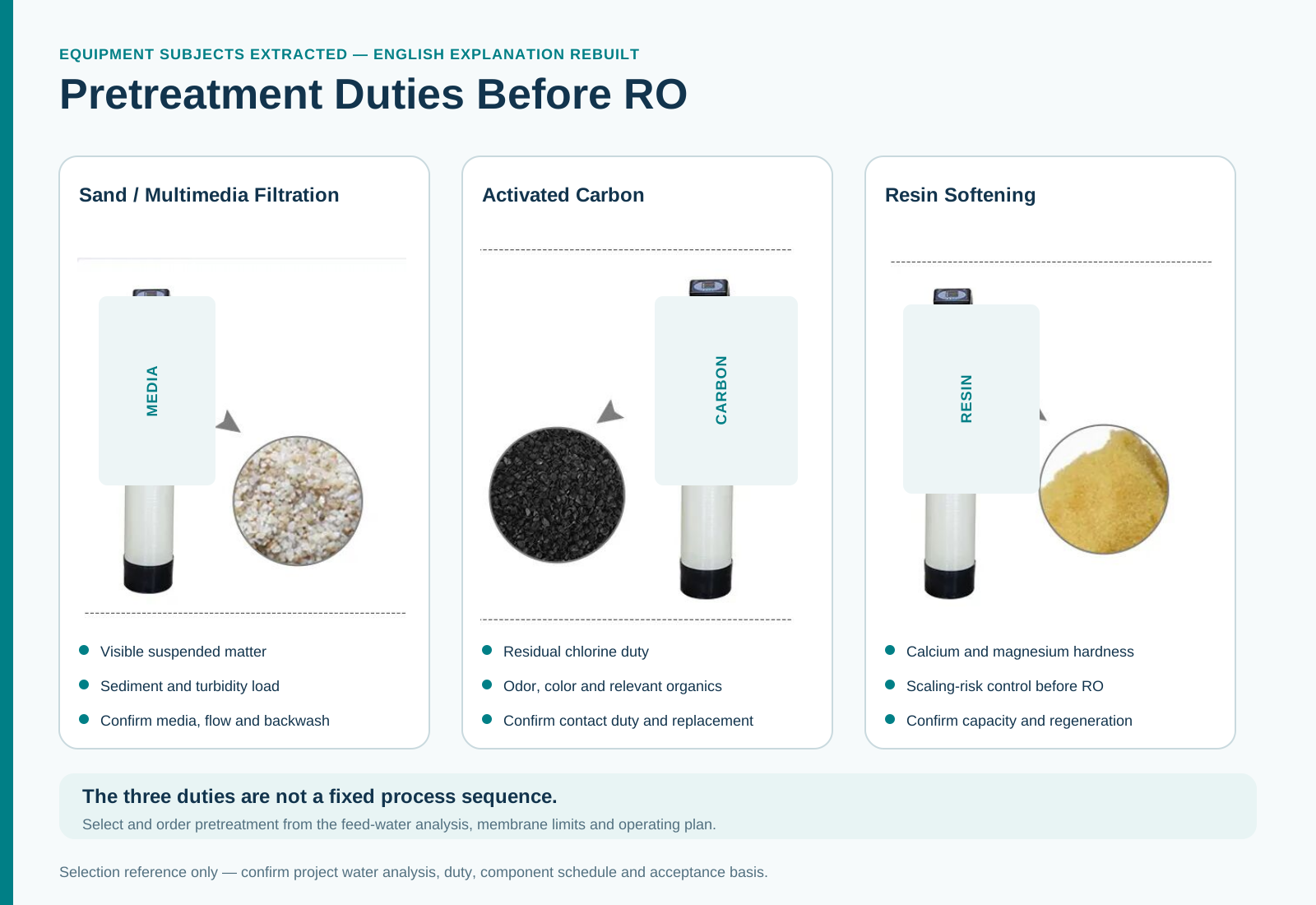
| Pretreatment duty | Source description retained | Project item to confirm |
|---|---|---|
| Sand or multimedia filtration | Removal of visible suspended solids, particles, sediment and related turbidity load. | Media specification, design flow, filtration rate, backwash basis and inlet/outlet criterion. |
| Activated carbon | Control of residual chlorine, odor, color and relevant organics or suspended matter. | Target constituent, media type, contact duty, replacement basis and microbial-control plan. |
| Resin softening | Removal of calcium and magnesium to reduce hardness and membrane scaling risk. | Feed hardness, resin capacity, regeneration arrangement, brine handling and whether softening is the selected scale-control method. |
| Final cartridge protection | The source component image includes a precision filter before the membrane system. | Cartridge grade, housing, monitoring points and replacement basis. |
For groundwater projects, review the separate well-water, softening and RO guide. The quotation should show each selected step on a process drawing and explain why it is needed for the submitted analysis.
How Should Industrial RO Membranes Be Selected and Maintained?
The supplied reference treats the membrane as the central water-quality component and names Dow and Huitong as preferred examples. A buyer may list a required make, an approved list or permission for an equivalent proposal. The quotation should still identify the exact membrane make, model, format, quantity and arrangement used in the design.
Membrane fouling can reduce output and increase operating pressure and energy demand. Ask how the pretreatment, operating records, flushing and cleaning plan protect the selected membrane. The source gives “about two years” as a replacement reference and immediately qualifies it by feed-water quality and equipment use. Treat that interval as a planning prompt, not a guaranteed service life or automatic replacement date.
Compare rejection claims under the same stated feed and operating conditions. The source suggests a 98% salt-rejection target and an outlet TDS around 3, but those two numbers do not form a universal cause-and-effect rule. A rejection percentage must identify its calculation and test basis; the outlet target must be checked against the actual feed and required point of use.
How Should Pressure Vessels, Wetted Materials and Pumps Be Specified?
The source recommends reviewing 304 stainless steel, 316L stainless steel and quality FRP for relevant body or vessel duties, and warns against unspecified carbon steel or low-quality FRP where corrosion, cracking or leakage could interrupt production. This is a material-selection checklist, not a statement that one material suits every chemical, pressure or budget.
| Equipment item | What to state in the bid | Why it matters |
|---|---|---|
| Pressure vessels and media tanks | Material, manufacturer, pressure rating, lining where applicable and the fluid in contact. | Corrosion resistance, mechanical duty and inspection requirements differ by component. |
| Frame, piping, valves and fittings | Separate structural material from wetted material; list connection and pressure classes. | A stainless frame does not define every wetted component. |
| High-pressure or booster pump | Make, model, duty point, wetted material, motor and control method. | The pump must meet the membrane design flow and pressure without becoming a reliability bottleneck. |
| Preferred pump brands | The source names CNP (Nanfang) and Shimge as examples; state whether these are mandatory, preferred or replaceable by an approved equivalent. | Brand alone does not establish the duty point, material or local service plan. |
What Components Should an Industrial RO Quotation Include?
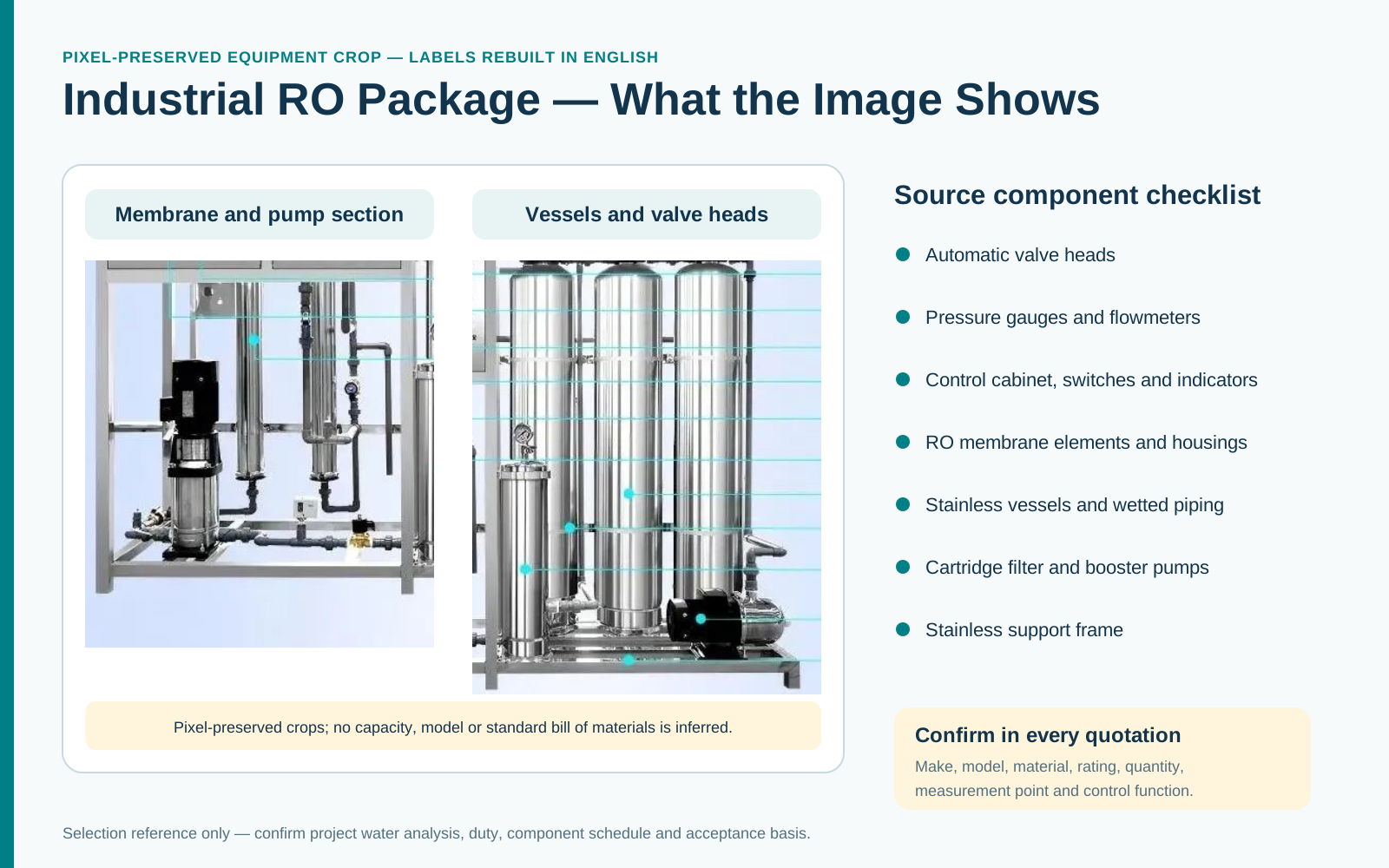
The image labels automatic valve heads, pressure gauges, flowmeters, a stainless-steel control cabinet, control switches and status indicators, 4040 RO membranes, stainless tanks, wetted-material piping and fittings, a precision/cartridge filter, booster pumps and a stainless base. Use those labels as a quotation checklist:
| Shown component group | Quotation confirmation |
|---|---|
| Automatic valve heads and pretreatment vessels | Which vessels are included, media duties, valve functions, backwash/regeneration logic and site drain or brine requirements. |
| Pressure gauges and flowmeters | Measurement point, range, accuracy, material and whether the reading is local, transmitted or logged. |
| Control cabinet, switches and indicators | Electrical makes, PLC/HMI, alarm list, interlocks, remote communications and destination voltage/phase/frequency. |
| RO membrane elements and housings | Make, model, format, quantity, array and the design conditions supporting performance. |
| Tanks, filter housing, pumps, piping and base | Materials, ratings, selected duties, included accessories and supply boundaries. |
How Do You Compare Industrial RO Suppliers and Quotations?
The source summarises poor buying outcomes as “three highs and two lows”: high failure frequency, high filter or membrane replacement cost and high service cost; low salt rejection and low service life. Use that idea as a comparison framework rather than a label applied to another supplier.
| Comparison field | What a comparable proposal should state |
|---|---|
| Performance | Net product flow and product-water targets under a named feed analysis, temperature and operating basis. Do not compare a bare “98%” with a fixed “TDS 3” unless the same calculation and feed basis are supplied. |
| Membrane and pump | Exact make/model, design duty and permitted equivalents. Named brands in the source are options to define, not universal standard supply. |
| Electrical and controls | The source names Schneider electrical components and a Siemens PLC as preferred examples. State required or proposed makes, I/O, HMI, alarms and communication scope. |
| Consumables and replacement | Cartridge, media, resin, membrane and chemical assumptions with replacement triggers and estimated quantities. |
| Downtime and support | Critical spares, fault response, remote support, local responsibilities and any redundancy needed by production. |
| Warranty | The source recommends requesting at least a one-year whole-equipment warranty. The actual quotation must define start date, duration, covered items, exclusions and responsibilities. |
Which Flow, Pressure and Automation Functions Should Be Specified?
The source says a differential-pressure display can help show filter condition and avoid blind replacement. To obtain that function, specify the upstream and downstream measurement points or a differential-pressure instrument. The image below shows operating pressure, concentrate pressure, concentrate flow and product-water flow. It does not by itself show a filter differential-pressure measurement.
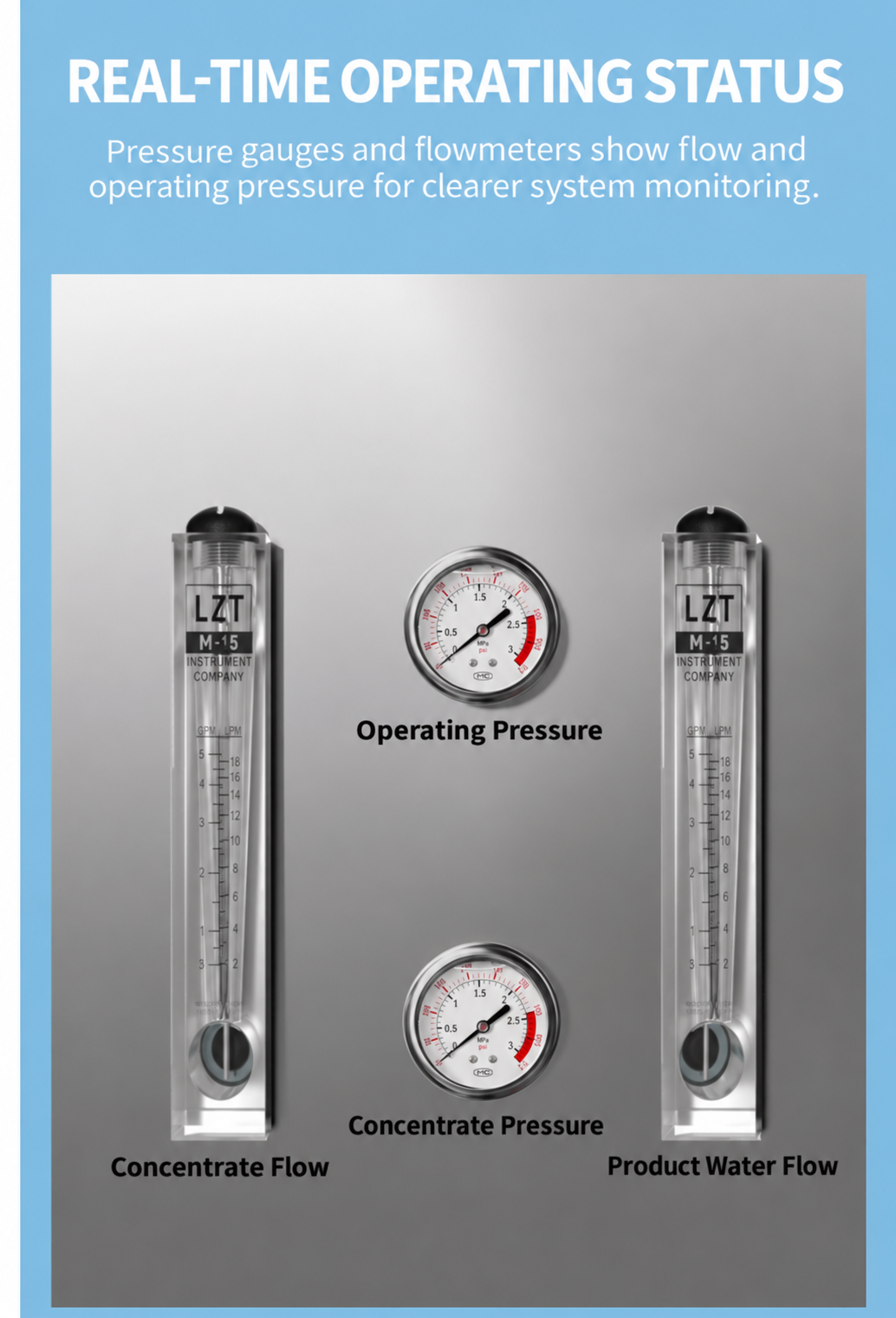
For automatic operation, agree start/stop, flushing, low- and high-pressure protection, tank-level interlocks, water-quality alarms and any media-filter backwash or softener regeneration sequence. The source describes one-button flushing and automatic start/stop as desired operating functions; the ordered logic and instruments must appear in the control narrative and I/O list.
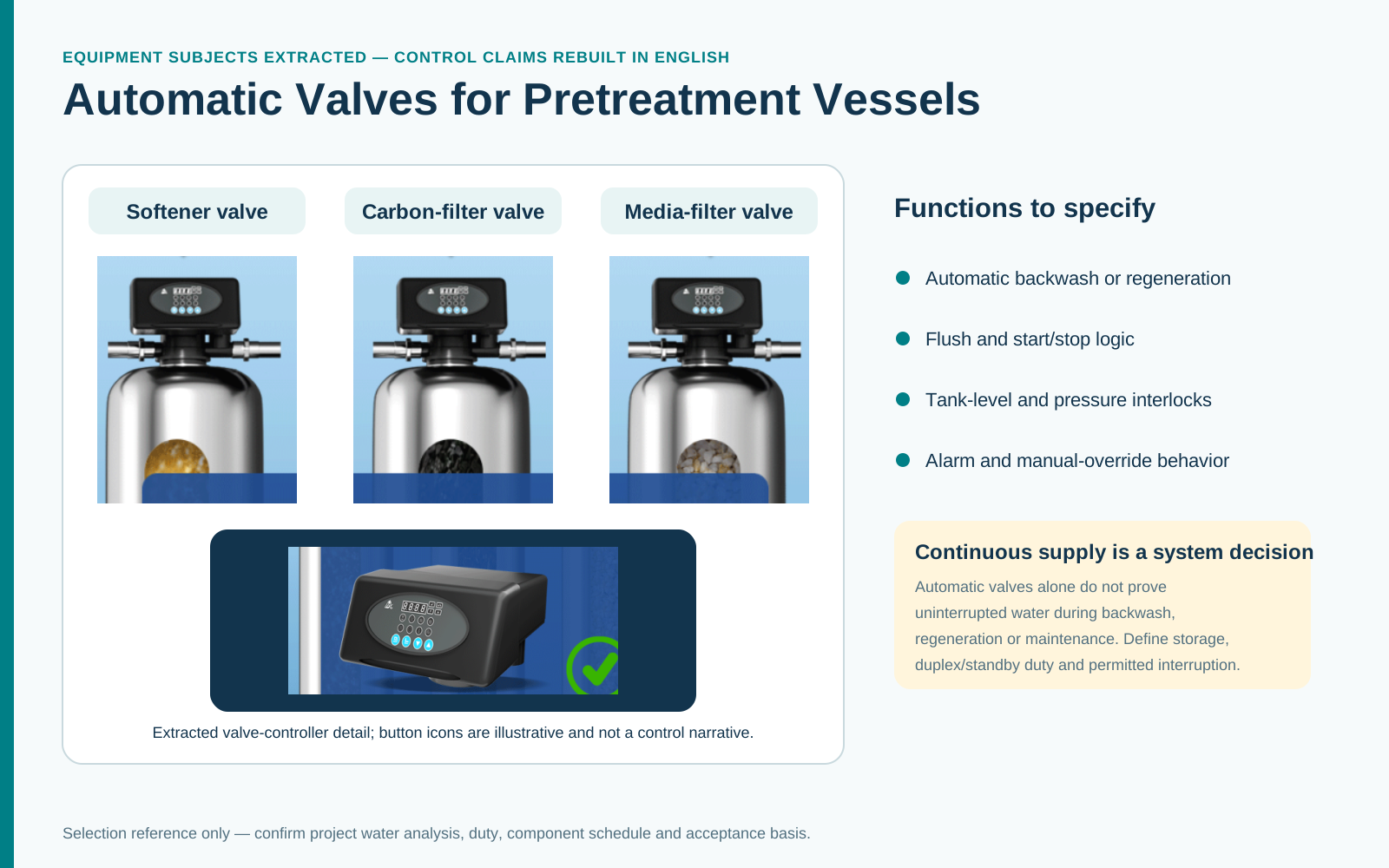
The image also states all-day water supply. Automatic valves alone do not guarantee uninterrupted delivery during backwash, regeneration or maintenance. Where continuous production is required, define the storage volume, duplex or standby arrangement, bypass conditions and permitted interruption in the quotation.
Which Lifecycle, Warranty and Supply-Scope Terms Should Be Compared?
- Membrane condition: operating pressure, product flow, concentrate flow and product-water quality trends used to trigger cleaning or replacement.
- Consumables: filter cartridges, media, resin, chemicals and critical spare parts, including what the initial supply includes.
- Maintenance workload: inspection, cleaning, backwash/regeneration and data-recording responsibilities.
- Warranty: requested duration, start point, covered assemblies, consumables, exclusions and claim procedure.
- Documentation: process drawing, equipment schedule, electrical drawings, control narrative, manuals, test records and acceptance responsibilities.
- Site boundary: delivery terms, tanks, foundations, utilities, installation, commissioning, training, drainage, concentrate disposal and integration with retained equipment.
What Should an Industrial RO RFQ Include?
- Buyer role: water-treatment contractor, EPC/integrator or facility owner.
- Industry, production process and the exact water point to be served.
- Source water, sampling point/date and the available analysis report.
- Required net product-water flow, daily demand, peak demand and operating hours.
- Required product-water parameters, units, sampling point and acceptance basis.
- Existing pretreatment, storage, distribution and downstream equipment to retain.
- Available feed flow/pressure, space, indoor/outdoor conditions, utilities and electrical supply.
- Required membrane, pump, vessel, piping, electrical or PLC makes, or permission for equivalents.
- Monitoring, alarm, communication, automatic valve and continuity-of-supply requirements.
- Requested equipment, drawings, testing, spare parts, installation and commissioning scope.
- Delivery destination, required schedule and applicable commercial terms.
- Known missing information and the person responsible for confirming it.
Send the available information through KONCHE project support. The engineering review can identify missing inputs and compare a project configuration with the published industrial RO equipment range.
Industrial RO Cost, Application and Selection Questions
What information do you need to get an accurate RO system quotation?
Provide the water source and available analysis, required net product flow and operating schedule, point-of-use quality target, site utilities, existing equipment, component preferences and the requested supply and service boundary. Mark unknown items so the supplier can identify the next tests or decisions.
Can I request a quotation without a water analysis?
You can start a preliminary discussion with the water source, application, required output and available results. Final membrane selection, pretreatment, recovery and performance conditions should remain subject to the required analysis.
Is TDS enough to select an RO system?
No. TDS describes bulk dissolved solids but does not show hardness, individual scale-forming ions, organics, particles, disinfectant residual or microbiological risks. The required analysis depends on the source and application.
Should I specify feed-water flow or treated-water flow?
State the required net treated-water or permeate flow first and label it clearly. Also provide available feed flow and pressure where known. A quotation should keep feed, product and concentrate streams separate.
What if I already have pretreatment equipment?
Share its process sequence, equipment list, operating data and water analyses before and after treatment. Identify what will remain, what can be modified and which connection and control interfaces the new RO package must use.
How much does an industrial RO system cost?
A comparable price needs the same feed water, net output, product-water target, materials, components, automation, documentation and site scope from every bidder. A bare flow rate or generic online price cannot define the installed project package.
The process values and component examples shown here are selection references, not universal guarantees. Final equipment selection, performance and commercial terms follow the confirmed project data and quotation.
Compare Industrial RO Equipment and Configurations
Use the product and process pages for the next engineering decision.
Review the published KONCHE equipment range and project-selection basis.
View equipment ↗PROCESS GUIDEHow Industrial RO WorksReview process blocks, water source, recovery and downstream treatment.
Read process guide ↗CONFIGURATIONSingle-Pass vs Double-Pass ROSeparate pass and stage, then select the arrangement from the quality target.
Compare configurations ↗Request a Project-Specific
Industrial RO Review
Send the feed-water report, required net product flow, point-of-use quality, operating schedule and requested supply boundary. KONCHE can identify the missing inputs before equipment selection.