Choose containerized seawater desalination when moving assembly into the factory solves a real site constraint, and the receiving site can support installation and maintenance. The enclosure can consolidate equipment, internal piping and electrical work, but it does not provide the entire water-supply project. Intake, foundations, utilities, concentrate handling and water delivery still need defined arrangements. For Saudi and other Middle Eastern projects, the deciding question is whether the integrated package can be operated and serviced under the actual site conditions.
What does a containerized seawater desalination plant include?
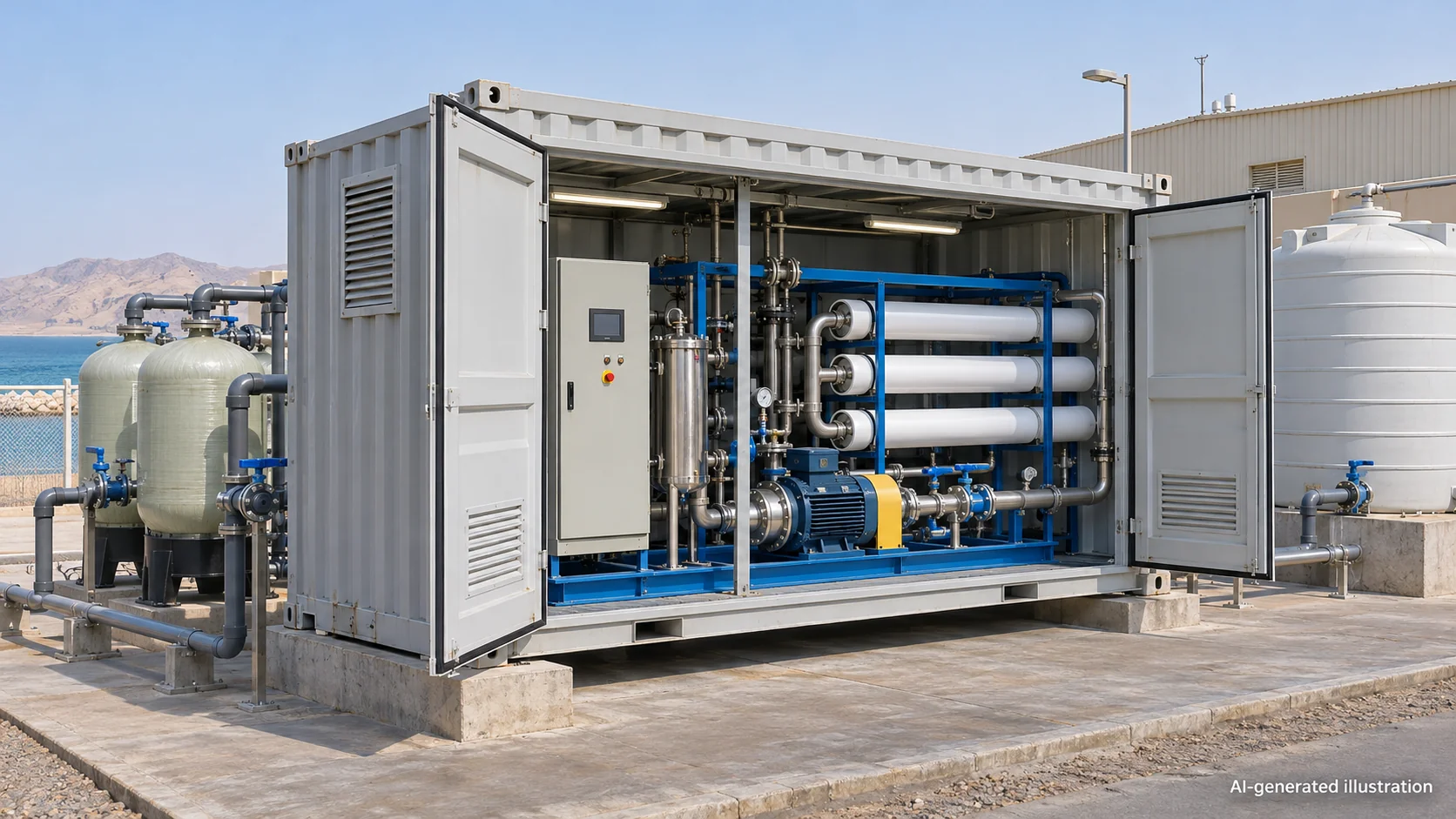
A containerized plant houses treatment equipment within an enclosure prepared for the proposed installation. The package may combine pretreatment, pumping, seawater RO, chemical dosing, controls and cleaning provisions. Some functions may instead occupy separate modules or remain outside the enclosure. The word “containerized” describes the packaging; the equipment schedule establishes what is actually included.
The treatment principle remains seawater reverse osmosis. The SWRO components guide explains the process functions, while the containerized water treatment system page describes the delivery format. Neither packaging nor a compact layout removes the need to match pretreatment and the membrane system to the incoming water.
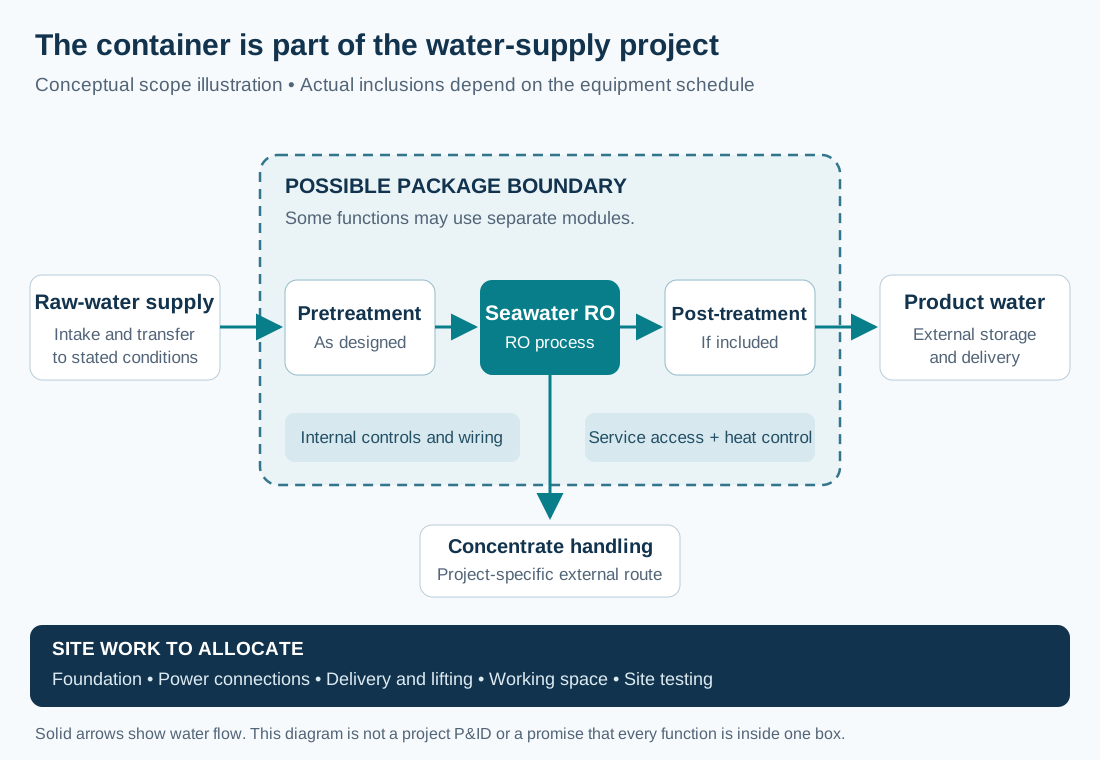
A useful way to view the package is as a defined section of a larger plant. An official containerized-system description identifies internal preconnection alongside external foundations, inlet and outlet connections, and power supply. Those external interfaces explain why a factory-integrated unit can reduce site assembly without becoming a complete, site-independent water source.
Where factory integration creates a useful advantage
Remote sites with limited assembly resources
On an island, at a coastal construction camp or at a remote industrial site, assembling separate equipment packages can be difficult. Moving suitable piping, wiring and equipment integration into the factory reduces the amount of that work left for the destination. Defined factory checks also provide a record of what was inspected before shipment.
The benefit is strongest when site assembly is genuinely the constraint. If the intake, electrical supply or concentrate outlet is still unavailable, an integrated treatment package cannot solve that delay. Factory readiness and site readiness have to converge before the plant can be commissioned.
Projects that need an enclosure but lack a plant room
A suitable enclosure can provide a controlled location for equipment that would otherwise need a building or separate weather protection. It can also consolidate access and organize internal services. This may suit a coastal facility with limited construction options.
However, the container footprint is not the full operating footprint. Doors must open, operators need safe working access, and parts must leave the enclosure during maintenance. External tanks, pretreatment modules, chemical storage and delivery equipment may add further space. A plot that fits the box but not its service area is too small for the proposed installation.
Projects with a credible relocation or staged-expansion plan
A packaged unit can be considered where future relocation has value, such as a temporary coastal worksite. That value exists only if the move is planned: transport access, lifting, disconnection, preservation and recommissioning remain part of the job. At the next location, water conditions and utility interfaces must be checked again.
Modular expansion is similarly conditional. Additional treatment modules need capacity in shared intake, power, pretreatment, storage and concentrate-handling systems. Spare space beside the first container does not establish that those shared services can support a second unit.
Which project scenarios favour a containerized system?
The following table gives engineering decision directions, not universal rules based on plant size or operating hours.
| Project situation | Where the format can help | What can overturn the choice |
|---|---|---|
| Temporary coastal camp with a planned move | Consolidated assembly and a defined transport package | Poor access at either site, costly lifting or unsuitable water conditions after relocation |
| Remote island facility | Less destination assembly and an enclosed equipment area | No practical unloading arrangement, limited spare-part access or inadequate site utilities |
| Permanent factory without a suitable plant room | An enclosure and organized package interfaces | Restricted maintenance clearance or an unresolved heat-management design |
| Facility with an existing serviceable equipment hall | Little need for an additional enclosure | A skid layout may use the existing building and maintenance access more effectively |
| Phased development | Treatment modules can be evaluated for staged additions | Shared utilities and water infrastructure cannot support the intended expansion |
| Vessel or offshore installation | Packaging may be assessed alongside installation constraints | Marine suitability, structural interfaces and applicable approval requirements remain unresolved |
There is no defensible universal capacity ceiling that makes every larger installation unsuitable for containers. Public containerized desalination project information demonstrates multi-container arrangements; it does not prove that such an arrangement is economical for every site. Compare the proposed layout and lifecycle requirements with a plant-room or other modular alternative.
Likewise, permanent duty does not automatically disqualify a containerized system. A permanent installation needs a convincing maintenance and operating layout, regardless of its packaging. The broader containerized treatment selection guide provides the related site-planning context.
The compact layout must remain serviceable
The main spatial tradeoff is between shipping a compact package and servicing it after arrival. A layout that looks efficient in a photograph may leave inadequate room to withdraw membrane elements, remove a pump or open an electrical cabinet.
Evaluate those maintenance movements on the layout before the arrangement is fixed. The relevant space includes the component, the handling method and the path to remove it from the enclosure. Doors, removable panels and external working areas must correspond to the maintenance plan. Access that depends on moving unrelated equipment should be made explicit in that plan.
This matters especially at remote sites. A component fault can become a much longer interruption when access was never designed or suitable handling equipment is unavailable. The SWRO membrane maintenance guide explains why membrane service is a normal operating consideration rather than an exceptional future event.
An enclosure also does not remove the need for local skills and consumables. Operators still need the procedures and resources required by the installed system. Remote monitoring, if separately provided, can support diagnosis; it cannot physically replace a filter, repair a leak or unload a spare pump. Choose the operating arrangement around the support the site can actually sustain.
Heat, salt exposure and materials need a site-specific design
For a Saudi coastal installation, evaluate the enclosure using the specified ambient conditions, solar exposure and internal equipment heat loads. A closed box is not automatically a suitable operating environment. Ventilation, cooling, insulation and equipment placement should form a coordinated design suited to the site and the installed components.
Airflow also has to be considered alongside dust and salt exposure. An opening that removes heat changes the enclosure's protection conditions; protection measures must still permit the required airflow and access. There is no basis here for assuming that every package needs the same cooling solution or that an enclosure alone prevents corrosion.
Separate external exposure from contact with seawater and process chemicals. The container shell, supports, pressure piping, valves and electrical equipment do not all face the same conditions. Materials, coatings and maintenance provisions must suit their particular service. The RO technical manual, including its discussion of construction materials, supports evaluating material selection against the corrosive environment rather than treating one alloy name as a universal solution.
For the buyer, the consequence is practical: an enclosure specification must describe the environment it is designed to manage. Generic claims about weather protection or a fixed corrosion-free lifetime do not answer that question.
Transport and external works can determine the commissioning date
The transport plan must reach the final installation position, not merely the nearest port. Route restrictions, delivery mass and dimensions, available lifting equipment, lifting points and placement access all belong in the logistics assessment. Being shaped like a shipping container does not establish that a loaded, modified treatment package can be handled by any available method.
The receiving site then needs a suitable foundation and the specified process and utility interfaces. Raw water must arrive at the conditions required by the package. Concentrate and other waste streams need a project-appropriate handling route, and product water needs whatever downstream treatment, storage and delivery the application requires. The seawater treatment overview shows why the RO outlet is only one point within that wider water-supply arrangement.
For drinking or industrial use, the final water specification follows the application. The container format does not itself establish water suitability, an authorized discharge route or project approvals. These are separate project requirements; this article does not prescribe a country-specific approval pathway.
A credible installation schedule therefore combines package completion, transport, external works and site testing. Factory integration can reduce a portion of the work, but a fixed promise of commissioning within a few days is not transferable between sites.
Compare containerized and plant-room options at the same output and water quality
The appropriate comparison is the completed installation delivering the same water quantity and quality. Include enclosure or building work, site assembly, transport and lifting, external services, maintenance access and the proposed operating arrangement. A lower equipment subtotal is not necessarily a lower complete-project cost.
Energy should also be compared at the same feed conditions, output and electrical boundary. Packaging alone cannot establish that a containerized system always consumes more or less electricity. Any difference needs to be traced to the actual pumping arrangement, auxiliary loads and operation. The commercial desalination buying guide provides the wider cost-comparison context.
The decision becomes clear when the enclosure removes a genuine site constraint without creating a larger maintenance, environmental or logistics problem. Where an existing plant room already provides those services and access, a skid arrangement deserves equal consideration. Where factory integration materially reduces difficult destination work, the container can be a useful delivery choice.
For a project assessment, use KONCHE's seawater desalination system information and send the site requirements: feedwater analysis, required product-water quantity and quality, site layout, environmental conditions and delivery access. Include whether relocation or expansion is a real requirement. These inputs determine whether container integration improves the project rather than simply changing its appearance.
Frequently asked questions about containerized seawater desalination
Can a containerized system run continuously?
The enclosure does not determine continuous-operation capability. That depends on the selected process, equipment, utilities and maintenance arrangement. Sustained water supply may also need storage or other provisions for interruptions; the operating plan must address them.
Is a skid-mounted unit the opposite of a marine unit?
No. Skid-mounted and containerized describe packaging; marine describes the intended service. Suitability for a vessel requires assessment of the particular installation and applicable requirements. Neither an enclosure nor an open skid proves or rules out that suitability.
Can the whole project fit inside one container?
That is a scope and layout question. Some functions may be integrated while intake, tanks, power interfaces, waste handling or downstream distribution remain external. The package boundary should be established from the equipment and site drawings, not the product label.
Does modular expansion mean uninterrupted supply?
Not automatically. Modules can share intake, electricity, controls or other infrastructure. If a shared service stops, several modules may be affected. The supply-continuity plan needs to identify those dependencies rather than simply count containers.
Is a container always cheaper than a permanent building?
No universal price ranking follows from the format. Compare the complete installed scope and operating requirements at the same output and water quality, including any existing building that can be reused. Transport, maintenance access and enclosure services can change the result.