120,000 m³/day Municipal Wastewater Plant: Open-Channel UV Disinfection in China
Published 27 November 2026 · Customer identity withheld · Project-specific configuration
Konche (Shenzhen) Water Treatment Technology Co., Ltd. supplied six KCW-UV35.84KW open-channel UV systems for a municipal wastewater treatment plant in China. The design flow recorded for the project is 5,000 tonnes per hour, equivalent to 120,000 m³/day over continuous 24-hour operation. Each system uses 112 lamps rated at 320 W, giving 672 lamps and 215.04 kW of specified system power across the project.
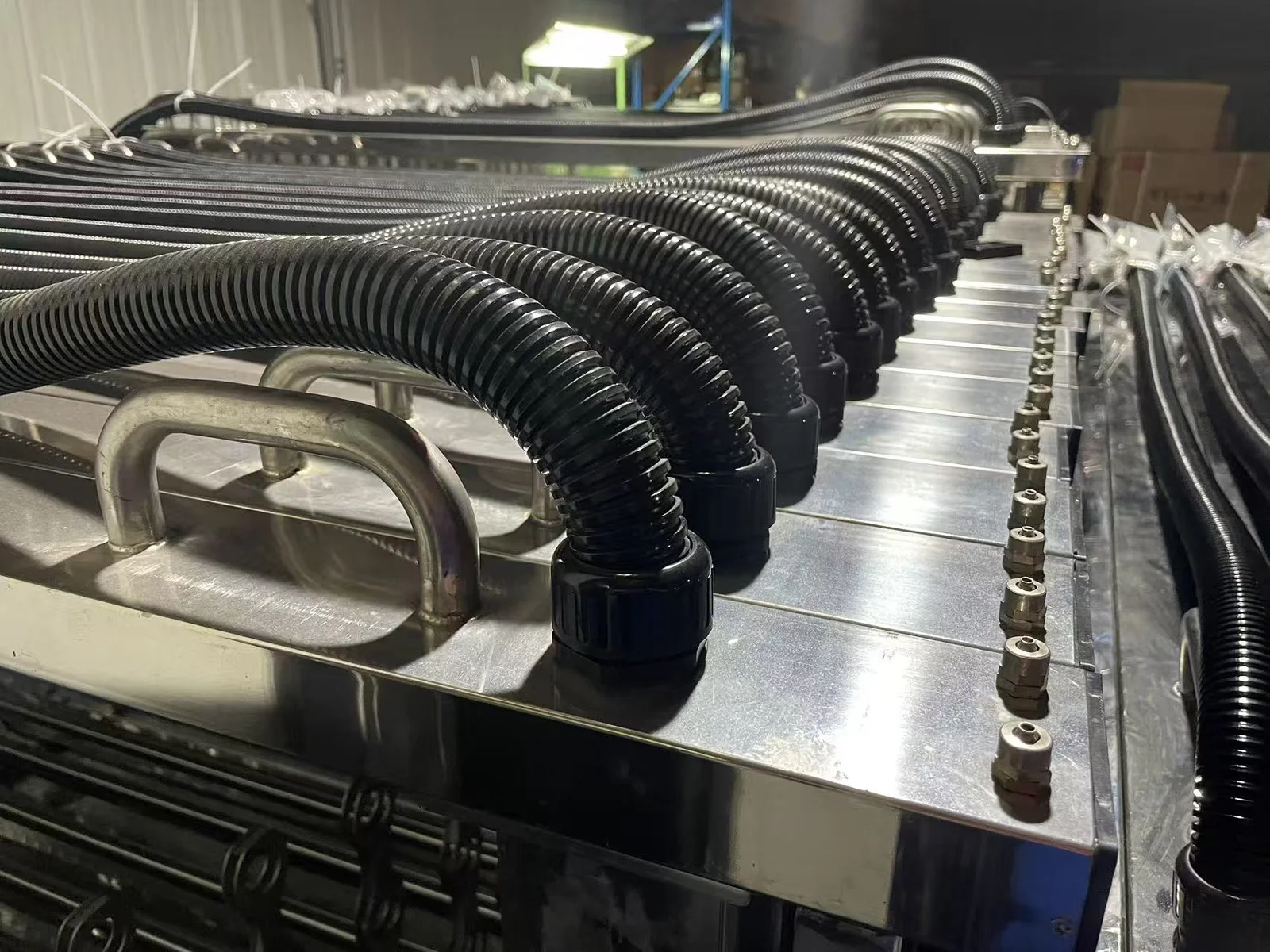
The supply also covers pneumatic cleaning, fixed overflow weirs, UV intensity and water-level monitoring, individual lamp-status alarms, and PLC/HMI controls with a SCADA interface. The project photographs below show the delivered equipment, connection details, installation process, treatment channel and UV equipment in operation.
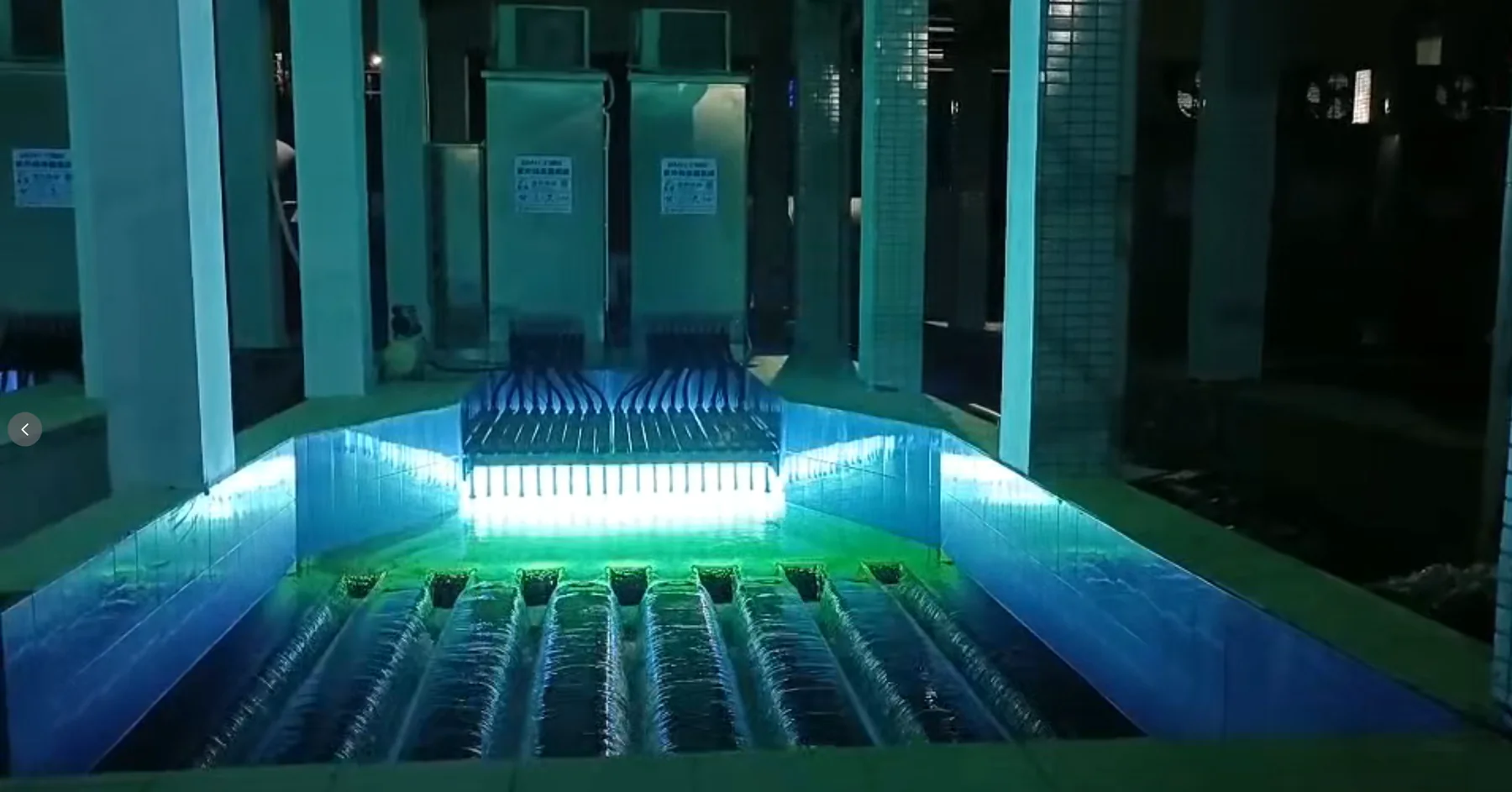
What Was Delivered for the 120,000 m³/day Project?
The project package consists of six open-channel UV systems and six fixed overflow weirs. Lamp assemblies, quartz sleeves, ballasts, stainless steel module components, cleaning equipment, monitoring instruments, controls, cabinets, cables and connectors were specified as one coordinated channel-disinfection package.
| Project item | Delivered configuration |
|---|---|
| Application | Municipal wastewater disinfection in an open channel |
| Project design flow | 5,000 tonnes/hour; 120,000 m³/day at 24-hour operation |
| System quantity and model | Six KCW-UV35.84KW systems, plus six fixed overflow weirs |
| Specified system power | 35.84 kW per system; 215.04 kW total |
| UV lamps | 112 lamps per system, 320 W each; 672 lamps total |
| Quartz sleeves and ballasts | 112 high-transmittance quartz sleeves and 112 electronic ballasts per system; ballast power factor 0.98 |
| Lamp-group and cleaning itemization | The project quotation lists seven lamp groups per system, each with 16 lamps, and separately lists 14 stainless module/cleaning assemblies, 14 pneumatic cylinders and 14 cleaning frames per system |
| Materials | 316L/316 stainless steel for specified module and wetted components; outdoor ballast-control cabinets with air conditioning |
| Cleaning | Pneumatic sleeve-cleaning package with air-compressor equipment |
| Controls and monitoring | Siemens S7-300 PLC, Siemens panel PC, SCADA interface, hardwired alarm contacts, UV intensity, water level and individual lamp-status monitoring, with audible and visual alarms |
| Equipment and channel dimensions | Equipment: 2.2 × 1.4 × 1.25 m per system; channel: 4.5 × 1.5 × 1.3 m; effective lamp immersion depth: 0.8 m |
| Electrical supply | 380 V, 50 Hz |
| Recorded design condition | Minimum UV transmittance (UVT) of 65%; suspended solids are identified as a factor affecting UV performance |
The 7-versus-14 figures describe two different lines in the supplied itemization: seven lamp groups with 16 lamps in each group, and fourteen stainless module/cleaning assemblies. They are retained separately here so that the source terminology is not silently collapsed into one module count.
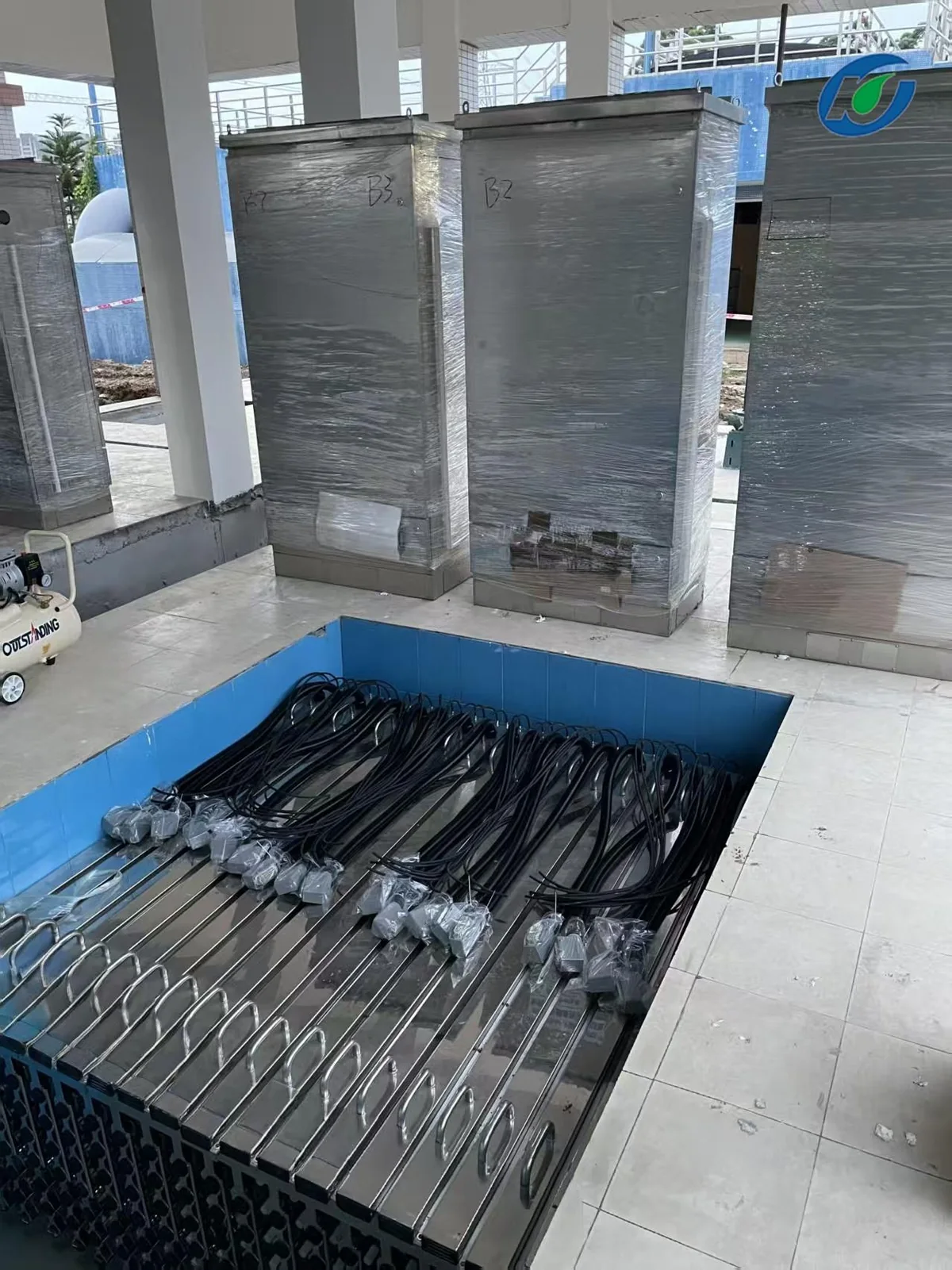
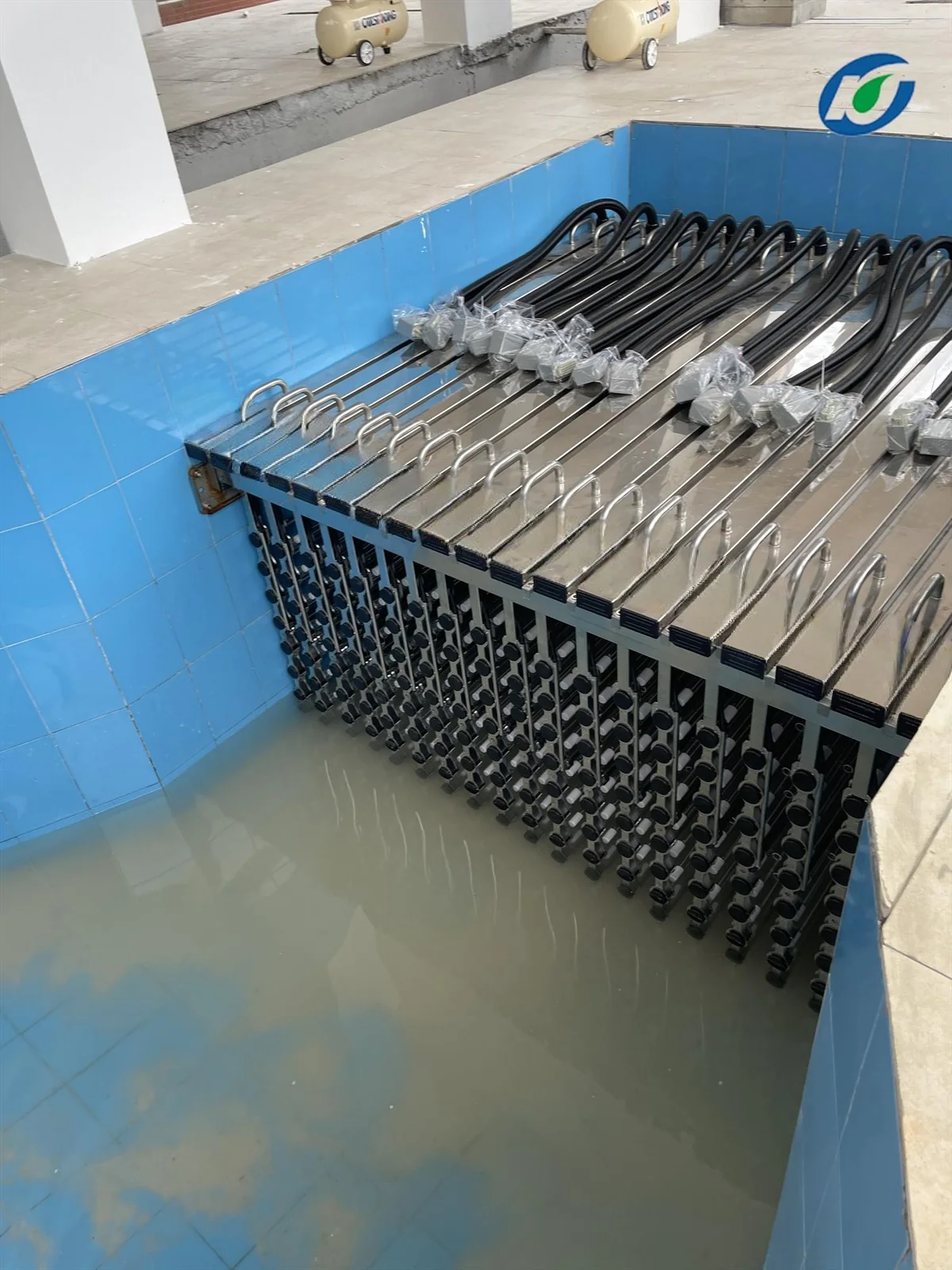
How Were 672 Lamps Distributed Across Six Systems?
Each KCW-UV35.84KW system contains 112 low-pressure high-output lamps rated at 320 W. A separate quartz sleeve and electronic ballast is specified for every lamp. Across six systems, that gives 672 lamps, 672 quartz sleeves and 672 ballasts.
This is a project-specific arrangement, not a fixed configuration for every KCW open-channel UV system. Lamp power, count, spacing, channel arrangement and operating sequence must be selected from the actual flow envelope, UVT, solids, disinfection target and civil interfaces.
How Was the Equipment Installed in the Existing Channel?
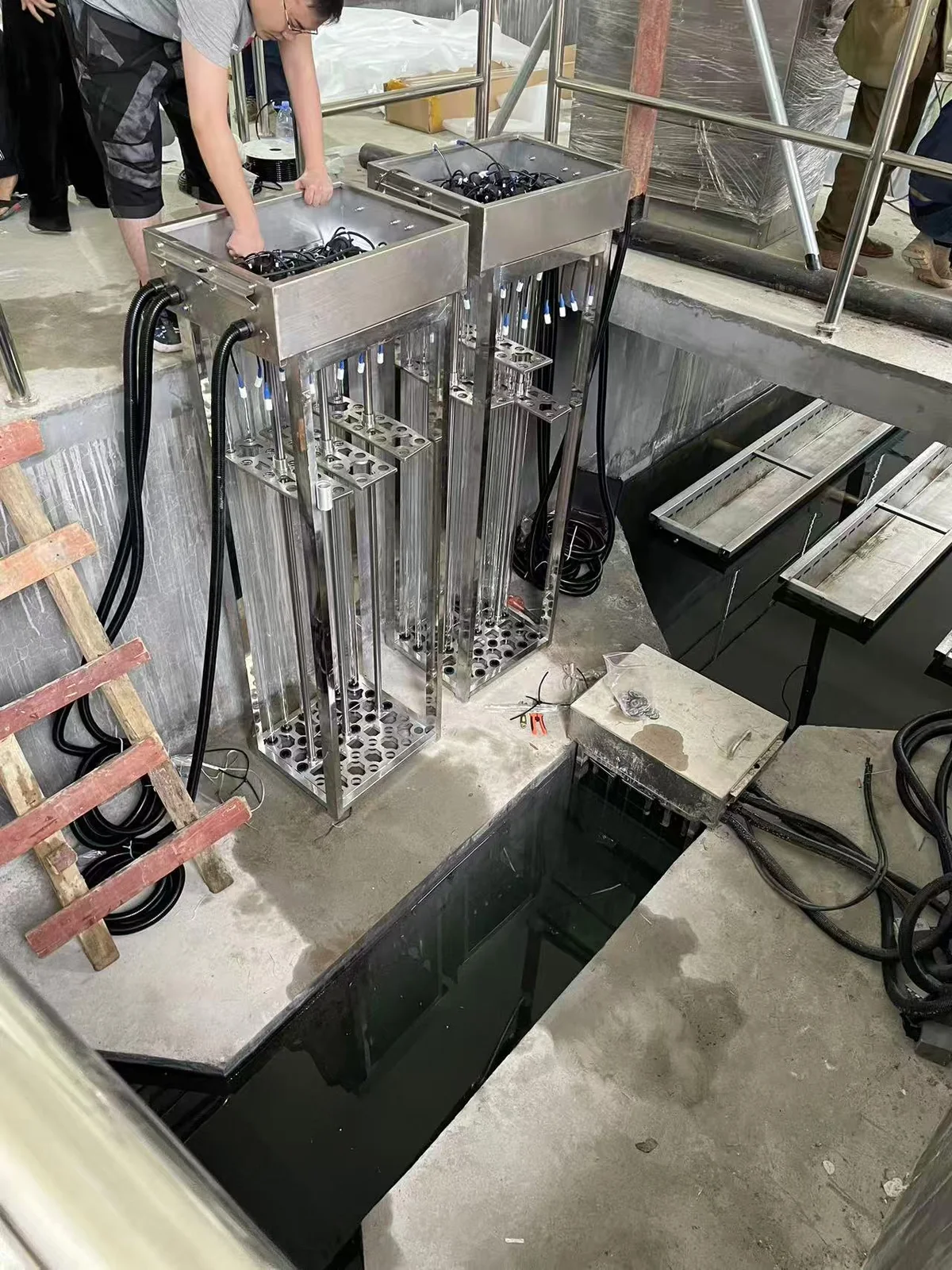
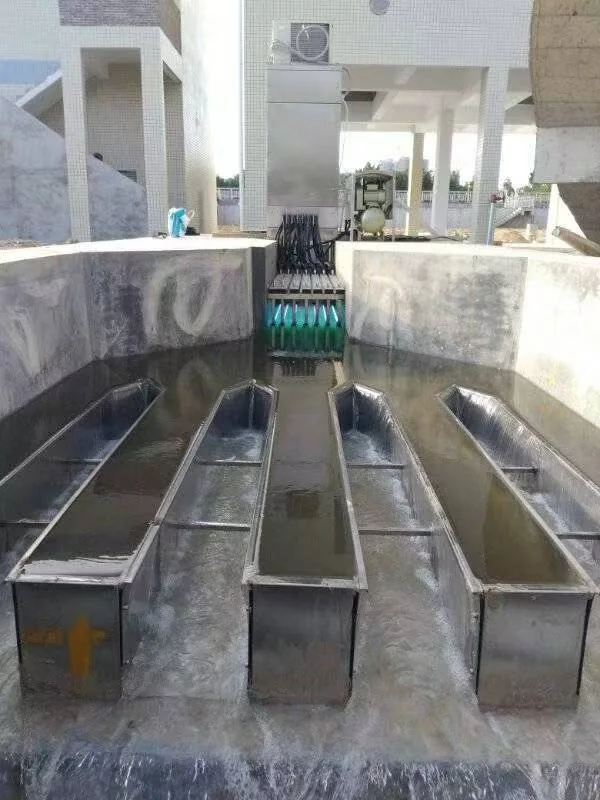
The equipment envelope and civil-channel dimensions were specified separately. The project records an equipment size of approximately 2.2 × 1.4 × 1.25 m per system and a channel size of 4.5 × 1.5 × 1.3 m, with an effective lamp immersion depth of 0.8 m. Fixed overflow weirs and water-level sensing help maintain the intended submergence as flow changes.
Site photographs show technicians assembling and lowering vertical lamp racks into the channel. They also show the wider flow-distribution structures upstream of the UV zone. These interfaces are why an open-channel proposal must be checked against the actual channel drawing rather than selected from daily flow alone.
Why Does SS Matter When the Target Is 10 mg/L?
The project information provided for this case records post-treatment water at SS ≤10 mg/L and fecal coliform ≤1,000 MPN/L after the disinfection step. These are project-specific figures, not a universal guarantee for the equipment.
The formal microbiological parameter in China's GB 18918 standard is fecal coliform, not E. coli. Under the Ministry of Ecology and Environment's amendment effective 1 March 2026, the Class I A fecal-coliform limit is 1,000 MPN/L for reuse and 10,000 MPN/L for non-reuse discharge. The applicable project permit and acceptance conditions therefore need to be confirmed for each outlet destination.
Which Controls and Cleaning Functions Were Included?
The controls package combines a Siemens S7-300 PLC and Siemens panel PC with a SCADA interface and hardwired alarm contacts. Operators can monitor water level, UV intensity and individual lamp status, with audible and visual alarms for abnormal conditions.
Pneumatic cleaning is included to reduce the loss of UV transmission caused by sleeve fouling. The project itemization records 14 cleaning frames and 14 pneumatic cylinders per system, together with air-compressor equipment. Cleaning frequency still depends on site water chemistry and operating history; iron, manganese, hardness, biological growth and other deposits can change fouling behavior.
For comparable projects, the UV sleeve-fouling and cleaning guide and the open-channel UV controls and SCADA guide explain how these functions connect to operating risk.
What Data Should an EPC Contractor Provide for Similar Sizing?
A 120,000 m³/day label is not enough to reproduce this configuration. A reviewable proposal should include:
- normal, minimum and peak flow, including the operating sequence of multiple channels;
- minimum UVT at 254 nm, TSS or turbidity, and any known iron, manganese or hardness-related fouling risk;
- the required microorganism limit, discharge or reuse destination, and any specified UV dose or validation basis;
- channel width, depth, available length, water-level range, head-loss allowance and lifting/maintenance access;
- electrical supply, PLC/SCADA protocol, alarm contacts and redundancy expectations.
See the UV system sizing guide for the broader selection process, or send the project inputs through the equipment project support workflow.
Project Questions
What was delivered for the 120,000 m³/day project?
Six KCW-UV35.84KW open-channel UV systems were supplied, together with fixed overflow weirs, pneumatic cleaning, PLC/HMI controls, SCADA interfaces, UV intensity and water-level monitoring, and individual lamp-status alarms.
How were 672 lamps distributed across the six systems?
Each system has 112 low-pressure high-output lamps rated at 320 W, for 672 lamps and 215.04 kW of specified system power across the project.
Did the UV system reduce suspended solids to 10 mg/L?
No. Upstream treatment is responsible for the suspended-solids target. The UV system provides microbial disinfection; TSS and UV transmittance are design inputs because particles can shield microorganisms and reduce UV penetration.
What post-disinfection target was recorded for this project?
The project information provided for this case records SS at or below 10 mg/L and fecal coliform at or below 1,000 MPN/L. Under the GB 18918 amendment effective 1 March 2026, the 1,000 MPN/L Class I A limit applies to reuse; the non-reuse limit is 10,000 MPN/L.
What data is needed to size a similar open-channel UV system?
Provide normal and peak flow, minimum UV transmittance, TSS or turbidity, the required microorganism or permit target, channel drawings, water-level range, electrical supply, control interfaces and operating redundancy.
Review an Open-Channel UV Configuration for Your Plant
Review the equipment project support process to define the design inputs and supply scope for your own project.
Send your normal and peak flow, UVT, TSS or turbidity, disinfection target, channel drawing and control requirements. Konche (Shenzhen) Water Treatment Technology Co., Ltd. can review the equipment configuration and civil interfaces. Request a technical proposal for your wastewater UV project.