UV can be an effective final microbial-control step for aquaculture effluent, but it is not a complete wastewater-treatment process. Start with the water’s destination, then check upstream solids and nutrient treatment, peak hydraulic load, minimum UV transmittance (UVT), the target organism or discharge objective, and how performance will be verified.
If these inputs are missing, selecting a unit by lamp power or average daily flow can create a system that looks adequate on paper but becomes unreliable during harvest, tank draining, filter backwash or other peak events.
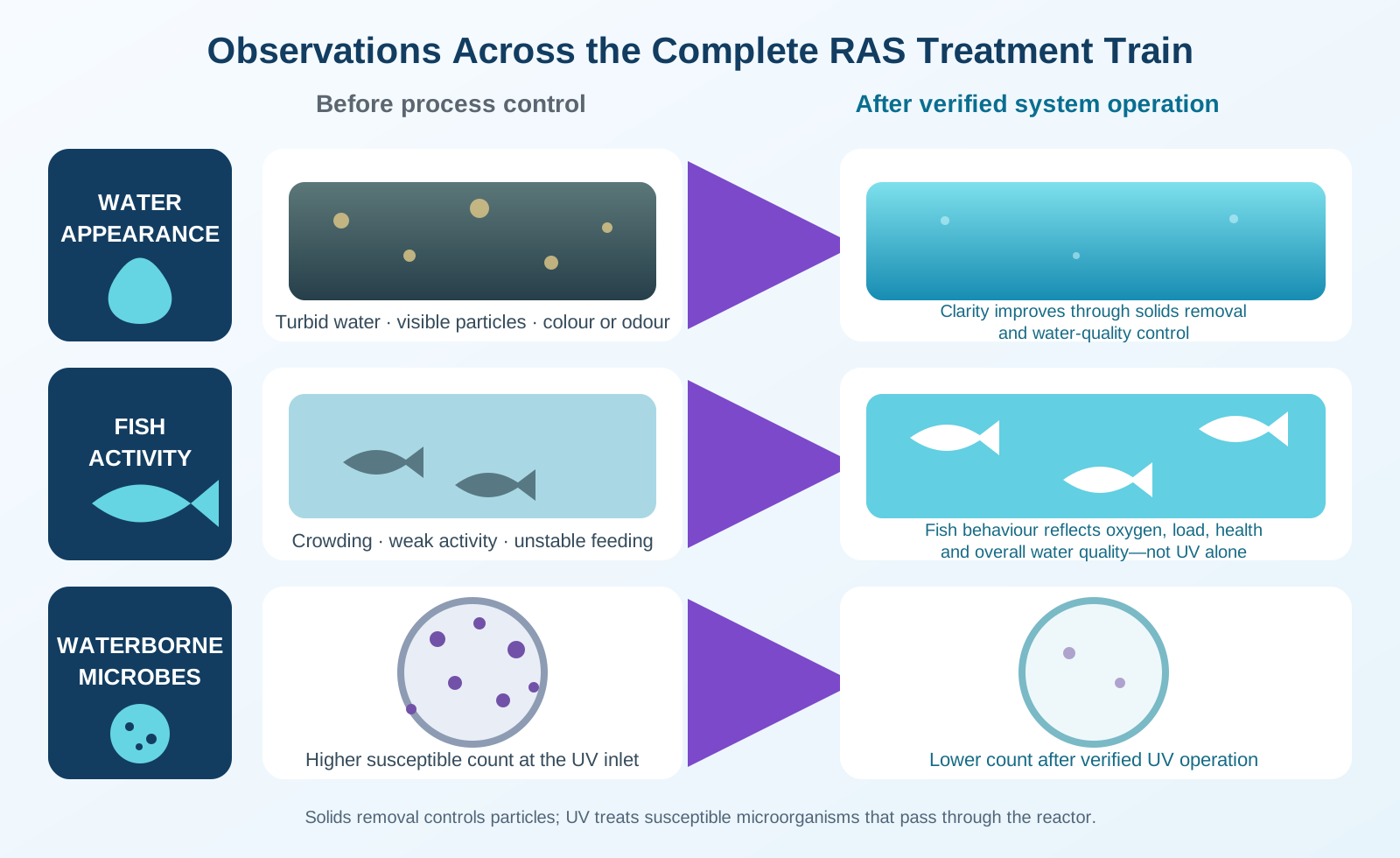
Start with the destination, not the UV unit
“Aquaculture effluent” can describe very different streams. A continuous RAS bleed is not the same as a short, high-flow tank-drain event. Backwash water, hatchery discharge and treated water for crop irrigation can also face different solids, salinity, microbial and regulatory requirements.
- Direct discharge to a receiving water body. The competent authority and permit determine the point of compliance and required parameters.
- Transfer to a municipal or centralized treatment system. The receiving utility may specify hydraulic, solids, salinity or pretreatment limits.
- On-site reuse. Irrigation, wash water or other applications require their own water-quality and exposure-risk assessment.
- Temporary storage before discharge or reuse. Storage can support settling, but it can also create a downstream recontamination point after UV.
ISO 25247:2026 addresses effluent reduction and discharge management for closed and semi-closed aquaculture systems. It does not turn UV into a universal compliance solution; local discharge or reuse criteria still control the project.
What UV does—and what it does not do
UV exposes waterborne microorganisms to ultraviolet energy as water passes through a reactor or channel. Its role is microbial inactivation. It can support a biosecurity or discharge-control plan when the water is suitable and the process is correctly operated.
UV does not replace the processes needed to manage:
- suspended solids, settleable sludge or backwash solids;
- ammonia, nitrite, nitrate, total nitrogen or total phosphorus;
- salinity or dissolved organic load; or
- a chemical contaminant that requires another treatment mechanism.
Particles can shield microorganisms and reduce UV transmission. WOAH aquaculture guidance recommends removing suspended solids before UV and monitoring treatment efficacy. UV should therefore be assessed after the required solids-removal and biological or chemical stages—not used to compensate for them.
Where should UV sit in the effluent treatment train?
Keep concentrated solids out of the UV stream
Backwash or sludge streams may be better thickened, settled or managed separately. Combining every waste stream can create a short peak with poor UVT and high particle shielding.
Put UV after the processes that improve optical water quality
Mechanical filtration can reduce shielding particles. Use the minimum expected UVT at the proposed UV inlet—not only a clear-water sample—as a selection input.
Check what happens after UV
Long storage, open channels, dirty tanks or cross-connections can reintroduce microorganisms. If the compliance sample is taken farther downstream, the section between the UV outlet and sampling point must also be controlled.
The five inputs that determine UV selection
1. Peak flow through the UV stage
Size the treatment step for the highest credible flow that must be disinfected, not the farm’s average daily discharge divided by 24 hours. Check simultaneous tank draining, filter backwash, harvest and cleaning, pump sequencing, infiltration and balancing-tank transfer. Equalization can reduce a short peak, but the peak cannot simply be ignored.
2. Minimum UV transmittance
UVT describes how readily UV light passes through the water. Clear-looking water is not a measurement. Dissolved color, organic matter, iron and fine particles can lower transmission. The UK Drinking Water Inspectorate uses UV254 absorbance to assess UV suitability; drinking-water thresholds should not be transferred to aquaculture effluent, but the measurement principle is relevant. Record wavelength and path length with each result.
3. Suspended solids and particle distribution
Two waters with similar turbidity can behave differently if their particle size and composition differ. Include TSS, upstream filtration and recurring solids breakthrough in the review. Solve unstable inlet quality rather than adding unverified UV capacity as a substitute.
4. Treatment objective and target organism
“Disinfect the water” is not a complete performance specification. State whether the project is controlling a named pathogen, meeting an indicator-organism limit, supporting biosecurity or adding a microbial barrier before reuse. Do not copy a dose from another farm, country or application without review.
5. Verification and operating philosophy
Define how the operator will know the process is available and performing. Depending on the project, this can include flow, lamp and ballast status, UV intensity or calculated dose, low-performance alarms, cleaning status, operating hours, inlet UVT and microbiological verification. An intensity percentage is not automatically delivered dose.
Closed-vessel or open-channel UV?
US EPA engineering guidance classifies UV reactors as closed-channel units, where water flows under pressure without a free surface, and open-channel units, where lamp racks sit in a basin or channel. Both can be appropriate, but they suit different hydraulic layouts. This is a project-screening checklist—not a claim that KONCHE offers a standard open-channel model for every aquaculture project.
| Project condition | Closed-vessel reactor | Open-channel system |
|---|---|---|
| Existing pressurized pipe | Often easier to integrate | Usually requires a hydraulic transition |
| Gravity discharge channel | May require pumping or a pressurized branch; confirm available head | May fit the existing hydraulic profile |
| Flow range | Confirm the reactor operating envelope | Confirm minimum and maximum water level and bank control |
| Footprint | Compact vessel, with lamp-removal clearance | Channel, access walkway and control structure require space |
| Maintenance isolation | Valves and safe drain/isolation arrangement | Channel isolation, lifting access and safe entry procedures |
| Expansion | Parallel reactors may be added | Additional banks or channel capacity may be possible |
Design for abnormal operation, not only normal operation
Bypass
A bypass can keep water moving during service, but bypass flow is not disinfected. State when bypass is allowed, where that water goes and how normal service is confirmed.
Redundancy
Where uninterrupted treatment is necessary, consider duty/standby capacity or multiple trains. Redundancy should cover realistic failure and maintenance cases, not just total installed lamp power.
Cleaning and access
Allow space to remove lamps and sleeves safely and confirm how the reactor or channel will be isolated, depressurized or drained. Base cleaning frequency on fouling and monitored performance, not a universal calendar.
Alarms and records
Route important alarms to an operator who can act. Record flow, UV status, maintenance and verification so a discharge issue can be traced to a process condition.
Commissioning: verify the whole treatment train
- Verify actual flow at normal and peak states.
- Confirm valve positions, bypass logic and interlocks.
- Record inlet UVT and solids conditions.
- Check monitor readings after the required warm-up and calibration procedure.
- Test alarms and the site response.
- Confirm the sampling point and microbiological verification plan.
- Establish clean baseline readings for future troubleshooting.
If water is stored after UV, include the storage and delivery route in verification. A compliant reactor outlet does not by itself prove the final discharge or reuse point remains controlled.
Information to send with an RFQ
- effluent source, destination and relevant species or farm process;
- normal, minimum and peak instantaneous flow, plus continuous or batch operation;
- typical and worst credible UVT with the test method;
- TSS, turbidity and upstream filtration details;
- target organism, indicator limit or authority-defined objective;
- pipe size and pressure, or channel dimensions and water levels;
- available headloss and hydraulic profile;
- salinity, temperature and material constraints;
- monitoring, alarm and data-output requirements;
- redundancy, allowable downtime, footprint and service clearance; and
- the proposed verification and sampling point.
KONCHE can review a flow-through UV stage as part of a wider treatment system. Final selection requires project water data and the applicable discharge or reuse requirements; lamp wattage alone is not enough.
Frequently asked questions
Do we need UV before reusing aquaculture effluent for irrigation?
Possibly, but the answer depends on crop, irrigation method, worker or public exposure, storage, local reuse rules and microbial quality. UV does not correct salinity, nutrients or chemical parameters.
Can UV treat raw backwash water directly?
Raw backwash often contains concentrated solids that shield microorganisms and foul equipment. Evaluate solids separation and equalization before UV.
Should the system be sized by average daily discharge?
No. The UV stage must handle the instantaneous flow that passes through it, including batch-discharge peaks.
Does one low outlet bacteria result prove the design will always comply?
It proves only the sampled condition. Verification should cover difficult flow and water-quality conditions, alarm response, downstream storage and the actual compliance point.
Can UV replace filtration or nutrient removal?
No. UV is a microbial-control step. Solids and nutrient treatment require their own processes, and effective solids removal helps UV operate reliably.
Related KONCHE resources
Use these pages to compare the general UV selection method and available equipment families.
Flow-through UV equipment and project integration routes.
View equipment →RAS SELECTION GUIDEUV for Recirculating Aquaculture SystemsSelect duty flow, UVT, placement and commissioning limits.
Read the guide →PROJECT REVIEWReview Your Effluent UV DutySend the peak-flow, water-quality and hydraulic inputs for an engineering review.
Start project review →- ISO 25247:2026 — Treatment of aquaculture effluent in closed and semi-closed aquaculture systems
- WOAH Aquatic Animal Health Code — disinfection of aquaculture establishments
- Mississippi State University Extension — Biosecurity in Aquaculture, Part 2
- US EPA Ultraviolet Disinfection Guidance Manual
- US EPA Wastewater Technology Fact Sheet — Ultraviolet Disinfection
- UK Drinking Water Inspectorate — UV disinfection