Shopping Mall: Municipal Water Filtration — 200 T/H Average Treatment Flow
Delivered project case published 27 October 2026 · Commercial client not named
KONCHE designed and manufactured a municipal-water filtration system for a high-end shopping mall in Shenzhen, using quartz sand and activated carbon. The design used 200 T/H as the average treatment basis and checked 243.33 m³/h separately as the maximum-flow condition. It prioritized the required throughput when selecting the sand-filtration rate. KONCHE completed on-site installation and commissioning, supported operation, verified performance against the project’s acceptance requirements and completed delivery.
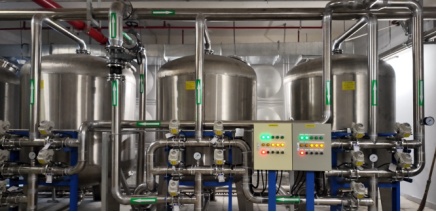
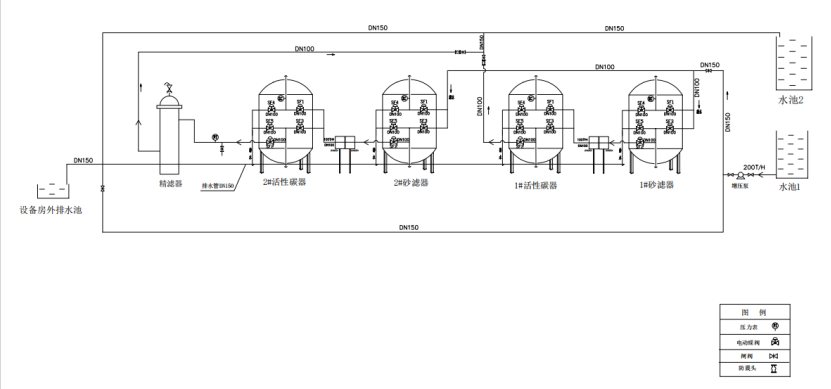
Project Overview: Municipal-Water Filtration for a High-End Shenzhen Mall
This large commercial complex needed high-flow pretreatment for municipal water. In our project design, we worked with an incoming pressure of approximately 0.20 MPa and two DN250 inlet pipes. Maximum daily water use was 1,887.9 m³/day, while average hourly use was 78.66 m³/h. We used these two figures to understand the building load, then used the treatment-flow figures below to size and check the water-treatment train.
We used 200 T/H as the average treatment quantity and checked 243.33 m³/h as the maximum-flow condition. This kept normal treatment demand separate from the highest building flow. The 243.33 m³/h figure was not treated as a continuous operating rating for each vessel or for the complete train.
Our responsibility covered process and system design, equipment manufacture, on-site installation and commissioning, operational support and performance verification through delivery. We configured the media-filtration section with four SS304 pressure-filter vessels: two for quartz sand and two for activated carbon. Both filter types used the KCG-AC-1600 vessel-container model, but they had different media and process functions. The treated-water performance met the project's acceptance requirements, and equipment delivery is complete.
What Design Inputs Shaped the Commercial Building Filtration System?
When we size a commercial building system, daily consumption alone is not enough. Average hourly demand can look moderate while the maximum flow is much higher. We also check the available inlet pressure because pipes, valves and media beds all consume pressure. The equipment room needs enough space for the vessels and pipework, access for media handling, and the water supply and drainage required for backwash.
We used each group of project numbers for a different engineering purpose:
| Design input | Project value | How we used it |
|---|---|---|
| Source water | Municipal network | Starting point for our process and water-quality review |
| Municipal inlet pressure | Approx. 0.20 MPa | Input to the upstream hydraulic check |
| Inlet arrangement | Two DN250 pipes | Included in the site's hydraulic design |
| Maximum daily water use | 1,887.9 m³/day | Building demand across the day |
| Average hourly water use | 78.66 m³/h | Ordinary building demand, kept separate from treatment capacity |
| Average treatment quantity | 200 T/H | Basis for normal treatment demand |
| Maximum flow | 243.33 m³/h | Checked separately from average treatment quantity |
| Filter-vessel count | Four | Two quartz-sand vessels and two activated-carbon vessels |
| Vessel material | SS304 | Construction material specified for the project |
| Vessel specification | Φ1600 × 2665 × 4 mm | Specified diameter, overall height and plate thickness |
When a client asks us to size a similar system, we need the full demand profile rather than one rounded flow number. Once we have the inlet pressure, peak demand, operating schedule, room layout, backwash supply and drainage conditions, we can check the hydraulics and installation constraints before preparing a quotation.
Why Were Quartz Sand and Activated Carbon Used as Separate Treatment Stages?
We used quartz-sand filtration and activated-carbon filtration for different jobs. The two stages shared the same vessel shell, while we selected and checked their media, loading and operating conditions separately.
For replacement-media planning, see our filter media and water-treatment consumables. This is a maintenance-support entry point; media selection must match the installed vessels and operating conditions described in this case.
| Treatment stage | Purpose in this project | How we defined its role |
|---|---|---|
| Quartz-sand filtration | Control suspended solids and turbidity loading before downstream use | Not used to remove dissolved salts or hardness; no fixed removal percentage stated |
| Activated-carbon filtration | Address residual chlorine, colour, odour and adsorbable portions of the organic load | Not treated as a solution for all organics, dissolved salts, hardness or every microbial risk |
| Valves and connecting pipework | Route water through the separate media stages and support operating sequences | No specific automation mode, duty/standby arrangement or performance result stated |
The U.S. EPA explains that granular activated carbon can adsorb compounds associated with taste and odour, natural organic matter and several organic contaminant classes. Because capacity depends on the carbon and competing substances in the water, we check actual loading instead of treating carbon as unlimited or universally effective (EPA treatment-technology overview). WHO guidance likewise notes that activated carbon can remove pre-applied chlorine and many, but not all, odour-producing substances. We therefore include loading and treated-water performance in the operating review (WHO taste and odour guidance).
We used KCG-AC-1600 as the shared vessel-container model, not as a single treatment-process designation. One set was filled with quartz sand and the other with activated carbon. In our specifications and quotations, we keep the media and treatment function clear whenever this type of shared vessel model is used.
Why Did the Project Use a 49.76 m/h High Sand-Filtration Rate?
For the sand filters, we used a per-vessel flow basis of 100 m³/h and a vessel diameter of 1.6 m. The relationship between flow, filtration area and filtration velocity is:
Rearranging for velocity gives:
Using the project calculation convention π ≈ 3.14:
Using π ≈ 3.14, we calculated the project selection value as 49.76 m/h. We used this as the high-rate sand-filtration basis because treatment throughput carried more weight than the greatest possible filtration effect. The trade-off reduced the filtration area needed for the duty and helped control the number and footprint of the vessels.
49.76 m/h was our value for this set of project inputs, not a standard rate for every building. The U.S. EPA notes that granular-media filter performance depends on media properties, bed depth, filtration-rate control, hydraulic loading, backwash and changes in flow; hydraulic overload can push particles through the bed and reduce treatment performance (EPA turbidity guidance, pp. 73–74). The UK Drinking Water Inspectorate also links rapid-filter operation and backwashing to media, bed depth, loading rate and raw-water quality (DWI rapid gravity filter guidance).
For every new building, our engineering team recalculates the rate from the raw-water solids load, target water quality, media grading, bed depth, allowable pressure loss, flow variation, backwash supply and drain capacity. We would not copy 49.76 m/h directly into another project.
How Were 200 T/H Average Treatment and 243.33 m³/h Maximum Flow Distinguished?
We used 200 T/H as the average treatment quantity and 243.33 m³/h as the maximum flow. We applied the first value to normal treatment demand and used the second to check the peak condition. We did not turn the maximum-flow figure into a continuous operating rating.
When clients send us both values, together with operating hours and flow variation, we can check normal operation and the peak condition in the same sizing exercise. An average alone leaves the maximum condition unclear; a maximum alone does not describe how the building normally uses water.
We kept maximum daily use of 1,887.9 m³/day and average hourly use of 78.66 m³/h in their building-demand roles. The 200 T/H figure remained the average treatment basis. Together, the values gave us a daily, hourly, normal-treatment and peak-flow picture.
How Did KONCHE Design, Manufacture, Install and Commission the Complete System?
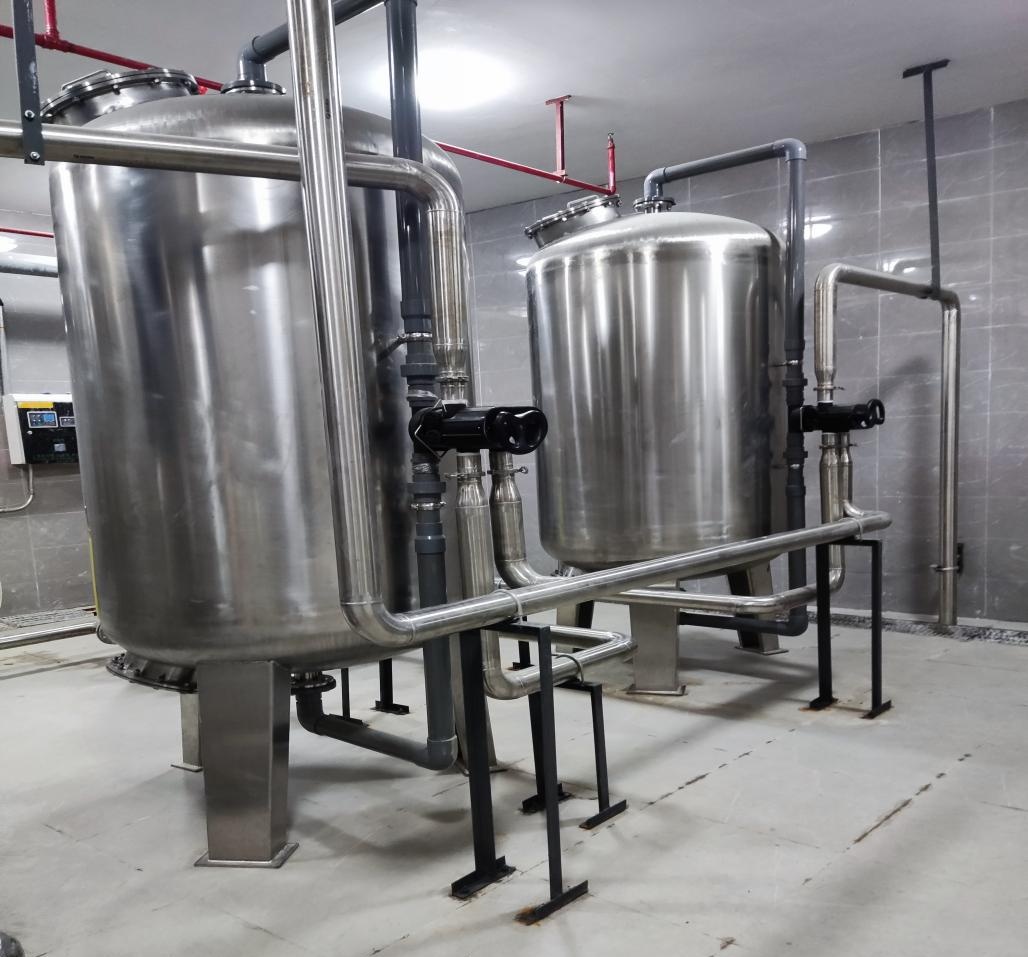
We designed and manufactured the complete water-treatment system for the project. Our media-filtration design comprised four SS304 vessels, divided into two quartz-sand filters and two activated-carbon filters. Each vessel was specified as Φ1600 × 2665 × 4 mm and used the KCG-AC-1600 container model.
We configured the vessels in sections suited to the site conditions: an upper head and inlet section of Φ1600 mm × 450 mm, a rolled cylindrical section of Φ1600 mm × 1,200 mm, and a lower head and leg section of Φ1600 mm × 1,015 mm. The design used four units in sequence, with connecting pipework, valves and controls supporting the separate filtration stages.
Our work continued through equipment manufacture, on-site installation and commissioning, and operational support. We verified that the treated-water performance met the project's acceptance requirements before completing delivery. The project photo shows the stainless-steel filter vessels and connecting pipework after installation.
How Do We Approach Similar Commercial Building Projects?
Start with water analysis and the required end use
Municipal water is not identical from one city or building to another. For this project, we selected sand and activated carbon for the pretreatment needs. For another site, we first review the source-water report and treated-water target before deciding whether softening, membrane treatment or disinfection is needed. Our water-testing equipment-selection guide uses a well-water example to explain this test-first method; we carry the method forward, not the well-water assumptions.
If the dissolved-solids target requires membrane separation, we can assess a reverse-osmosis water-treatment system and compare single-pass and double-pass RO. Hardness or dissolved-salt conditions may also lead us to assess softening or RO. This softener and RO selection example shows the decision process in a well-water setting, so we would recalculate it for the actual source.
Treat the source-water context as part of the design
We do not copy the same equipment list across different water sources. Our river-water pretreatment example shows how a higher and more variable suspended-solids load changes the pretreatment task. A separate rainwater treatment case applies the same principle to another source and end use. In each new project, we make source conditions part of the specification.
Keep hydraulic conditions and operation in the same review
We review filtration rate, vessel area, pressure loss, backwash and drainage together. Higher throughput can reduce the installed filtration area, but it can also reduce the filtration-effect margin and change the operating cycle. To make that check, we ask clients for the available inlet pressure, allowable downstream pressure, backwash-water source, drain capacity, equipment-room access and whether water service must continue while one vessel is being serviced.
Where a building has a defined microbial-control objective, we can evaluate UV water treatment as a separate downstream step. It was not part of the confirmed scope for this project. If storage is included in another system, we also review it separately because microbial conditions can change after treatment. Our article on bacteria regrowth in RO-water storage explains that separate design issue; it is not part of this mall project.
What Information Do We Need for a Comparable System?
When a client requests a quotation, we first need the water and operating conditions before we name the equipment. Please send:
- a recent raw-water analysis and the required treated-water quality;
- source type and any seasonal or operating variation;
- average treatment quantity, maximum flow, daily consumption and operating hours;
- available inlet pressure and required pressure at downstream use points;
- equipment-room dimensions, access route and installation constraints;
- backwash-water availability and drain capacity;
- preferred materials, power supply, controls and monitoring interfaces;
- delivery, installation, commissioning, documentation and service boundaries.
We use these inputs to define the treatment train and explain the vessel-selection basis. They also give us a sound basis for discussing cost. Commercial filtration cost depends on the flow basis, vessel count and material, media, valves and controls, piping, access, backwash, documentation and scope. Without those inputs, one price per cubic metre per hour does not describe a workable project quotation.
Frequently Asked Questions
Why did this commercial mall use both sand and activated-carbon filters?
We gave the two stages different jobs. Quartz sand was used to control suspended solids and turbidity loading. Activated carbon was used for residual chlorine, colour, odour and adsorbable portions of the organic load. We do not state a fixed removal percentage because actual performance depends on the inlet water, media and operating conditions.
Why was a 49.76 m/h sand-filtration rate selected?
We calculated this project-specific high rate from 100 m³/h through a 1.6 m diameter vessel. The project prioritised treatment throughput over maximum filtration effect. For a new building, we would recalculate the rate from the water quality, media, bed depth, pressure loss, backwash and treated-water target rather than copy 49.76 m/h.
What is the difference between 200 T/H and 243.33 m³/h in this project?
We used 200 T/H as the average treatment quantity and 243.33 m³/h as the maximum flow. We checked them as different load conditions and did not present the maximum-flow figure as continuous operating capacity.
What scope did KONCHE complete for this commercial-building project?
We completed process and system design, equipment manufacture, on-site installation and commissioning, and operational support. We also verified that the treated-water performance met the project's acceptance requirements and completed delivery. That acceptance result applies to this project's water and operating conditions.
What data are needed to size a commercial building water filtration system?
We ask for the raw-water analysis, target water quality, average and maximum flow, daily use, operating schedule, inlet pressure, allowable pressure loss, space and access, backwash-water and drainage capacity, electrical supply, control needs and scope boundaries. These data give us a stronger sizing basis than a single nominal flow.
How much does a commercial building water filtration system cost?
Cost depends on the verified water and hydraulic requirements, vessel material and count, media, valves and controls, piping, footprint, delivery and site-service scope. We do not disclose the project price. We review the water report, demand profile and site constraints before preparing a project-specific process and quotation.
Request a Project-Specific Review
Send us your raw-water report, average treatment quantity, maximum flow, target water quality, available pressure, backwash and drainage conditions, and equipment-room dimensions. MEP and EPC teams can also provide control preferences, delivery boundaries, access limits and documentation requirements. Our engineering team can then prepare a project-specific proposal covering process design, equipment manufacture, site installation and commissioning, operational-support boundaries and delivery.
Plan a commercial building
water-filtration system.
Send KONCHE your water report, normal and peak flow, inlet pressure, room layout, and backwash and drainage conditions for a project-specific review.
Request a Technical Proposal and Quotation ↗